Category Archives: Finance and economics

The World Cup: Evolution from Celebration of Football to Money-Making Exercise

“No decision will be taken before the upcoming 2014 FIFA World Cup Brazil, as agreed by the FIFA executive committee.”

Source? An official FIFA statement, via the Guardian. Topic? Whether the 2022 World Cup in Qatar will be held in the summer or winter, of course; it’s only been the topic that’s consumed most international football fans and FIFA observers in the past few months.

The timing though? Immediately after Jerome Valcke, the FIFA secretary general, suggested to a French radio station that the World Cup might be moved to November 2022 after all.

Confused? You’re not the only one. But what’s been made apparent from the Qatar World Cup 2022 debacle, is that besides all the confusion and suspicions, the focus has firmly been taken away from what the World Cup is supposed to celebrate: football, the game itself.

Sure, the talk has revolved around Qatar’s temperatures in the summer, which would make for harsh conditions for players and fans alike, but surely that would’ve been a factor in the decision-making process leading up to awarding Qatar the host rights, instead of a topic to be discussed afterwards.

That Sepp Blatter and FIFA want to bring the World Cup to the Middle East is not a secret: Back in November, he even entertained the idea of hosting the tournament across several countries in the Gulf region, according to the Telegraph. So the globalization of football and the expansion of FIFA are two key items on the agenda, and both politics and money are equally prominent at the heart of all this, as we studied in an earlier article on the World Cup controversies.

But how exactly did the World Cup get to this current state? To answer that question, let’s go back and trace the evolution of the world’s most prestigious tournament from celebration of football to money-making exercise.

Laurence Griffiths/Getty Images

The Olympics: Eternal Rival and…Founding Father?

To understand the World Cup’s evolution and growth, we must first consider the history of the Olympic Games, eternally seen as the World Cup’s rival tournament in terms of global reach and prestige.

The distinction is always made that the Olympics celebrate not just one sport, but sport as man’s pastime, while the World Cup is only the gathering of footballing nations in the world—and before the United States’ entry and strong showing, not even encompassing the entire world. The World Cup’s proponents point to the final as the premier spectacle in world sport, with no single sporting match able to match its global appeal.

In reality, while they might be rivals now and trying to outdo each other every two years, it didn’t start out that way. In fact, the World Cup has the Olympics to thank for its current iteration and success, because it was the Olympics that gave birth to the World Cup as we know it.

When FIFA was founded in 1904, international football—indeed, professional football—was a phenomenon only affordable for a few countries, and when football was inducted into the Olympic Games in the summer of 1908, only amateurs were represented. Any attempt at organizing a truly international football tournament was undermined by the lack of professional setups in most countries around the world.

But when Uruguay won both the Olympic football tournaments in 1924 and 1928, FIFA, with then president Jules Rimet as a visionary driving force, stood up, took notice, and most importantly, set about realizing his dream. The first FIFA World Cup was to be staged in 1930 in Uruguay, with politics—what else?—at the heart of the host location decision: It was to be the 100th anniversary of Uruguay’s independence, and it was to be made not a great celebration of the game itself, but a spectacular political statement.

How else to explain it, given that the Uruguay national football association was willing to cover all travel and accommodation costs incurred by participating teams? As even FIFA.com concedes, that possible profits would be shared with participants and deficits taken on by the host country won Uruguay the first ever World Cup hosting rights.

The 1934 competition was held in fascist Italy under the dictatorship of Benito Mussolini, and Rimet, according to this excellent Independent feature on his life, was already criticized for politicizing football.

Before the advent of television and the phenomenon of globalization, the World Cup had surrounded itself with politics and money.

(A footnote to add, though, is that Jules Rimet’s vision and dream of uniting the world through sport and creation of the World Cup earned him a Nobel Peace Prize nomination in 1956. Perhaps, hopefully, the World Cup at its heart was actually more than a celebration of the beautiful game, but a triumph of humanity.)

Carlos Alvarez/Getty Images

The Context: Globalization and Technology

But just as we can’t give the Olympics all the credit for introducing the concept of a FIFA World Cup, so Rimet and FIFA can’t claim all the glory for growing the tournament from a small competition featuring just a few countries in Montevideo, Uruguay, to the global spectacle that was the 2010 World Cup in South Africa.

As ever, context is key, and the explosion of global business and trade, just as it’s played a huge role in the history of the 1900s, is an integral part of the World Cup’s continued evolution. Before the business side of things took over, though, first came the phenomenon of television.

According to this TIME feature, the impact of television on the World Cup’s boom cannot be understated: From 1954 to 1986, the number of TV sets worldwide “increased more than twentyfold, from a little more than 30 million to more than 650 million.” This laid the foundations for a truly groundbreaking moment in football history.

The first live World Cup games were broadcast in Europe in the 1954 tournament, which reached only a handful of audiences due to the low volume of matches shown, but the potential of television and TV advertising was already apparent. (Not that the Olympics were to be beaten, of course: The 1936 Summer Olympics were the first to be broadcast on TV to local audiences. International broadcasts came in 1956.)

Fast forward a decade and a half. Spying an opportunity to conquer the world of football and reap the ensuing economic benefits in 1974, was new FIFA president Joao Havelange, who upon taking office turned his organization into a modern international NGO, putting in place the infrastructure, people and income-centered mindset of a corporation.

The only thing left to do for the World Cup, which previously featured 16 national teams, was to expand. And expand Havelange did, opening the doors to developing countries with eight additional slots (which have since been further increased to a total of 32 participants since France 1998), as discussed by Tim Vickery for The World Game. The Havelange era also saw the introduction of the FIFA U-17 World Cup, FIFA U-20 World Cup, FIFA Confederations Cup and FIFA Women’s World Cup.

The costs of hosting such an immense global tournament in one country were too much to bear for one host country and FIFA, and thus came the idea of corporate sponsorship of the World Cup. Havelange struck deals with Horst Dassler, heir to the Adidas fortune, for the German sportswear company and other big-name corporations like Coca-Cola to fund the tournament, paving the way for the commercialization of international football.

So while the advent of television advertising led to increased premiums for marketers to get their spots onto World Cup TV screens, behind the scenes within FIFA itself was a concerted movement to pump money into the World Cup—with political and economic influence once again the main motivation behind all these changes.

(The name Joao Havelange may be familiar. He was the same FIFA ex-president that resigned in April 2013 after a FIFA ethics report ruled that he had taken bribes, as reported by BBC Sport. The culprit in question? International Sport and Leisure [ISL], founded by Horst Dassler. Politics and money, indeed.)

Getty Images/Getty Images

The 1990s and Onwards: Spiraling Out of Control

If ever there was a curious decision in the history of world sport, the idea to host the 1994 World Cup in the US was clearly one, at the time. In hindsight, however, it was just another calculated plan from Havelange to bring the game to North American shores, which had yet to be consumed by football fever.

The legacy was stunning: To this date, USA 1994 still holds the total attendance record (over 3.5 million) and the average attendance record (68,991), according to USSoccer.com. The US’s advancement to the round of 16 for the first time since 1930 contributed to soaring TV ratings.

(Leading up to its hosting of the World Cup, the US also put in place their first ever professional soccer league. It’s no surprise that Major League Soccer was founded in 1993, a year before the 1994 World Cup. We explore the growth of soccer in the US in another article.)

The introduction of the World Cup in practically uncharted territory in 1994 was met with enormous financial successes, and since its foray into the world leader of commercialized sport and corporate sponsorship, FIFA have never looked back. The World Cup has since traveled to Asia (2002) and Africa (2010), goes to Russia in 2018, and brings us to the Middle East in 2022.

According to this Economist article, the World Cup broadcasting rights for France ’98 were sold by FIFA in 1987, before the stunning 1994 American success, for $344 million. An indication of how far the World Cup and FIFA have gone: In 1998, at the time of the article, ISL—which would later collapse, of course—had agreed to pay $2.2 billion to show the games outside America.

The groundwork for corporate sponsorship was laid by Havelange, but was taken to new levels under the leadership of current president Sepp Blatter. Let’s consider the 2010 World Cup, for example: According to a UPenn study, FIFA’s revenues related to the South Africa tournament amounted to a staggering $1.022 billion, of which $650 million belonged to broadcasting rights.

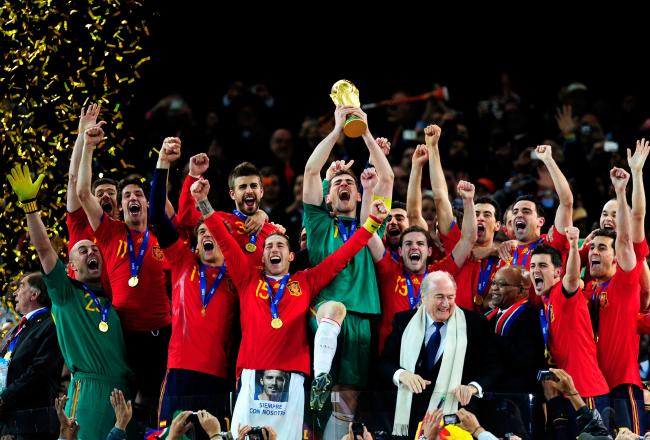
Participating national teams are in on the act too: FIFA was to provide $420 million to all participants and the football league teams providing players to the national teams, $30 million of which would go to the World Cup-winning team (Spain). First-round teams qualified automatically for $8 million each, while $1 million in preparation costs were provided to each participating football association.

This was brought about by the stellar line-up of corporate FIFA sponsors, known as “partners,” which included Adidas, Coca-Cola, Emirates Airlines, Hyundai-Kia Motors, Sony and Visa, who were “guaranteed exposure in the tournament stadium” and would receive “direct advertising and promotional opportunities and preferential access to TV advertising.”

The cost? A minimum of between 100 and million euros through to 2014. By which time, of course, the next World Cup cash cow will be held this summer, this time in Brazil.

Clive Mason/Getty Images

Conclusion: It’ll Only Get More Expensive From Here

Is it damning or merely inevitable that corporate sponsorship and incessant marketing efforts are now part and parcel of any World Cup?

In the build-up to this summer’s tournament, the allegations of corruption have been brushed aside after Havelange’s resignation in 2013, while all the talk of political and commercial interests have been directed towards the distant 2022 World Cup in Qatar, still eight years away.

It’s no longer news—rather, it’s an accepted fact—that the World Cup is now considered an extremely lucrative opportunity for brands and nations alike; this Fox article on Nike and Adidas’ brand battle pre-World Cup is now just part of the fabric. In fact, any sports company—or indeed any business entity at all—would be condemned for not taking advantage of a World Cup year to promote its business.

And so it’s only going to get more expensive from here. The spending and rights associated with the premier world football tournament have skyrocketed in the past decade or so, with the help and under the influence of a few key players, but the brand-new stadiums that are to be constructed in host countries are just the tip of the iceberg when it comes to World Cup spending.

But it’s the World Cup. Just as FIFA continue to rake in the cash, we football fans will continue to ignore the commercial influences and political battles and focus on the spectacle that will unfold before our eyes when the first whistle is blown on June 12 at the Arena de Sao Paulo.

An event of this magnitude only comes once every four years, after all. When the winning team hoists the Jules Rimet trophy on July 13, for once the celebrations will be directed entirely towards the football that they have played, not the money they will make.

This article first appeared on Bleacher Report, where I contribute regularly on Liverpool and the Premier League, and at times on the business of football.

How Much Is Liverpool’s Luis Suarez Worth in the Current Transfer Market?

Hi-res-456857877-luis-suarez-of-liverpool-celebrates-scoring-their_crop_north
Paul Gilham/Getty Images

The breaking news this Friday is that on the back of some truly incredible performances in the Premier League this season, Luis Suarez has put pen to paper on a new long-term deal at Liverpool, the club announced today.

There’s no disputing that Luis Suarez is one of the most feared and in-form players in all of world football. Having scored 17 goals and assisted four for the Anfield club in just 11 Premier League games, he has put himself firmly into the bracket of the world’s very best players.

Following the furore over Gareth Bale’s transfer to Real Madrid—which some outlets, like BBC Sport, have reported as the world record transfer fee, and others, like NESN, have claimed to still be No. 2 to Cristiano Ronaldo’s—football fans are naturally up in arms regarding player valuations.

Just a few months ago in the summer of 2013, Arsenal had a high-profile bid for Suarez rejected. Their £40 million plus £1 bid, based on a rumored clause in his contract, attracted nothing but scorn from the Liverpool hierarchy, who claimed that he wouldn’t be available even for £55 million, the going rate of Uruguayan strike partner Edinson Cavani, according to The Guardian.

So how does one go about valuating players’ transfer value? Are values arbitrarily assigned, or do they have some factual basis underlying all the public proclamations from managers and chairmen?

Without insider access to the boardroom and to the private financial accounts of most Premier League football clubs, here is a guide to working out how much Luis Suarez is actually worth in the current transfer market.

Paul Gilham/Getty Images

Transfer Fee

Let’s start first with the most visible element: the transfer fee.
In what will surely be known as one of the landmark bargains of this decade, Luis Suarez signed for Liverpool from Ajax Amsterdam on January 31, 2011, the last day of the 2011 winter transfer window. His transfer fee, according to BBC Sport, was around £22.7 million.

From a financial perspective, regardless of what percentage of the transfer fee was paid up front to Ajax, Suarez’s transfer fee will be amortized over the course of his contract, which was initially five and a half years. (It has since been extended in the summer of 2012.)

Simple arithmetic gives us an approximate annual cost for Suarez, excluding his wages (which we’ll get to below), of £4.13 million.

To date, he has been at Anfield for around two years and 10 months, but for the purposes of simpler calculation, let’s consider Suarez as having been at the club for three years.

By January 31, 2014, he will have completed three years of his initial contract with two and a half years left, which would mean that the as yet “unpaid” total amortization cost would come to around £4.13 million multiplied by 2.5, or £10.3 million.

Previous Wages

With a base reference cost of around £10.3 million, let’s consider the second aspect: wages.

While Suarez’s starting wages in his first contract at Liverpool were about £40,000 a week, according to the Mirror, the new and improved contract he signed in the summer of 2012 tripled his weekly compensation to about £120,000.

Assuming the standard of 52 weeks in a year, this comes to a yearly total of around £6.24 million a year, just in wages.

Having signed his most recent contract at the beginning of August 2012, Suarez would be approximately a year and a half into his improved deal by the end of January 2014, keeping with the same benchmark time frame we suggested above.

By then, there would still be two and a half years into his contract left to run, which would come to a total of £15.6 million.

At this point in our calculations, Suarez’s base value thus far is £10.3 million plus £15.6 million, which comes to about a total of £29 million.

Alex Livesey/Getty Images

New Wages

Now it’s time to consider the rumored new package that Liverpool have supposedly offered him. And this is where the less concrete part of our analysis starts.

While Liverpool’s official announcement yet again cites ”long-term” contract, this BBC Sport article claims that Suarez will be earning £160,000 a week until the end of this season (another half year), and then £200,000 a week for the next four years, in a deal that runs until 2018 and makes him the highest-paid player in the club’s history.

Based on these numbers, his entire new contract is worth a total of £42.6 million, which brings his whole valuation into a new light and onto a new level.

Let’s return to the base reference cost of £10.3 million. If we add this new £42.6 million wage value onto the reference cost, then a new total of about £52.9 million emerges.

Alex Livesey/Getty Images

Club Performance 

Of course, we also have to take into account Liverpool’s performances and financial rewards as a result of their on-pitch displays.

Notice that the underlying assumption behind Luis Suarez staying at Anfield would be that Brendan Rodgers is able to lead his team to the Champions League next season: After all, a player of Suarez’s caliber deserves to be plying his trade at the top level of club football.

With this in mind, let’s venture into the world of Premier League finances and attempt to very roughly estimate how Suarez could potentially have his value further enhanced by his club’s performances.

According to the official Premier League website, the end-of-season payout based on league performance for Liverpool in the 2012/13 season came to a total of around £54.8 million.

However, given that the Reds finished in seventh place and considering our top-four assumptions to keep Suarez, let’s take Arsenal as a reference: The Gunners, who finished fourth under Arsene Wenger last season, raked in a total of £57.1 million, which we will use as a rough guide for a minimum league payout.

With Champions League qualification and assuming that Liverpool progress into the group stages of next year’s competition, we can refer to UEFA’s minimum group stage payout according to their official website: UEFA states that “each of the 32 teams involved in the group stage will collect a base fee of €8.6m,” which translates to about £7.2 million.

As a result, a minimum total of £64.3 million will probably arrive in Liverpool’s coffers just for playing in the Champions League group stages.

The Deloitte Money League, published every year, is a fascinating insight into the finances of the top European football clubs. Its 2013 installment reveals that Liverpool’s total revenues for the 2011/12 season were £188.7 million, comprising of £45.2 million from matchday revenue, £63.3 million from broadcasting and £80.2 million from general commercial activity, including sponsorships and partnerships.

As with any corporation, Premier League clubs will have bonus schemes in place, and Liverpool will be no exception. For the purposes of this basic calculation, we will purely take into account the revenue that comes with Champions League qualification, and not Liverpool’s overall income.

A wholly generous assumption is that the 20 players registered as Premier League players for Liverpool will divide the £64.3 million that comes with a group stage venture, and Suarez will get five percent of that, netting £3.2 million in addition to the previous base.

(This estimate, when considering his contributions to Liverpool’s 2013/14 season—he has been involved in 21 goals, 54 percent of Liverpool’s total haul of 39 thus far this campaign—and a logical bell-curve bonus distribution according to performance, may in reality not be too far.)

Paul Gilham/Getty Images

Conclusion: £56.1 million

So what do we end up with?

Take the £52.9 million we estimated based on amortization of Suarez’s transfer fee and a projection of his future bumper contract and add the estimated performance-based bonuses of £3.2 million, and we arrive at the princely sum of £56.1 million, which, coincidentally (or not), was the almost the same rate the aforementioned Cavani left Napoli for.

If we go back to the Express article, we find that Suarez’s previous deal was reported to also include image rights in his weekly wages, so all inclusive, the figure of £56.1 million may be an accurate reflection.

Turns out this benchmark might have been chosen on purpose by the Liverpool hierarchy back in the summer.

But that’s only if we were to stick with a purely financial valuation of Luis Suarez, who, if he stays on at Liverpool, will surely go down as one of the club’s greatest-ever players in time.

Taking that into consideration, and the message that Liverpool would be selling its talisman and most important player of the current period, Brendan Rodgers may well consider Luis Suarez to be worth much more than £56.1 million.

Add that to Suarez’s current form at the club and his apparent turnaround in his commitment to Liverpool, and he might just be priceless in the eyes of all Liverpool fans.

Football is an emotional game, after all.

This article first appeared on Bleacher Report, where I contribute regularly on Liverpool and the Premier League.

The Football Business Column: The Money that Goes to Agents, Technology and Stadiums

football agents

The Money that goes to Agents

We can’t go anywhere in football without hearing about the money side of the game, such is the prevalence of commerce, sponsorships and brand partnerships, and the importance of financial might and ambition. So when it was announced this summer that the Premier League spent a record £630 million in the transfer window, no one really batted an eye.

It couldn’t have come as a big surprise though, given the enormous TV deals that were secured by the Premier League with broadcasters Sky and BT Sport. After all, the number of big signings and the amount of big money being flown around this summer—not least that mind-boggling world record deal for Gareth Bale—showed that money has become less and less of an object to Premier League clubs. (Crystal Palace paid £8.5 million for a League One player, Dwight Gayle from Peterborough.) It turns out, though, that it’s not just the Premier League, and it’s not just the signing fees.

As we saw from the Neymar megadeal to Barcelona, there are (too) many parties involved in a transfer deal. There are “investors”, “stakeholders”, agreements to play friendlies, first-option commitments and, of course, agents. And when your dad happens to be your agent and you happen to be Neymar, your family can suddenly become €40 million richer.

But it’s not just in conjunction with the biggest names in football that agent fees are considerable. The Football League released a report last week on agent fees at the Championship, League One and League Two levels, and the results were quite staggering. In the 2012/13 Championship season, 23 clubs (Blackpool excepted) paid a total of over £18.5 million in agent fees for 431 agent-involved deals, meaning that, on average, each club spent over £800,000 in payments to agents and each deal cost £43,000.

And that’s just at the Championship level. We await (dread) the official numbers affiliated with the Premier League for more discussion (depression). We haven’t even asked the all-important question yet: Are agents even worth it? (Blackburn Rovers spent over £3.5 million in agent fees—which is more than enough for a quality Championship-level player—and ended the season closer to relegation.)

The Money that goes to Technology

When we talk about money in the Premier League, the topic inevitably focuses on the lack of it spent on youth development and as such the promotion of homegrown talent, which adversely affects the performance of the English national team. And we all know the history of underachievement of said English national team in international tournaments, specifically in penalty shootouts, quite unlike their Premier League counterparts.

Fear not: Money can also be a solution there! Need to provide players with a simulated match environment? With a realistic atmosphere like a World Cup Finals penalty shootout? No problem. Engineering company BAE Systems are currently working with UK Sport, “the UK’s high performance sports agency,” to produce virtual reality simulators for Olympians and Paralympians to better prepare them for real-life tournament scenarios, and according to this Guardian report, this technology could be on its way to football as well.

And why not? Given the amount of money devoted to the mental and physical side of football these days—there’s also the sports science side, which has led to the spawning of many a sports science department at major football clubs, as well as the data analysis side—it’s only natural to see money being thrown at technology that can give teams and players that slight extra chance of success.

But is it really that smooth-sailing? Will virtual reality be able to compare to a real-world penalty shootout environment where everything is at stake? Unless BAE add a feature that projects a virtual reality of burning effigies in the penalty takers’ minds, it might not be enough…

The Money that goes to Stadiums

As ever, England isn’t the only country with huge financial burdens in football. Let’s cross the Atlantic for a moment and look at Major League Soccer, where DC United’s proposed new stadium has attracted criticism for its fee.

$300 million is the sum in question for the Buzzard Point, Washington DC location, and while there are obvious benefits to fans of the club and league, the mooted amount has been met with significant criticism from the DC Fiscal Policy Institute, who will have had the current economic climate in mind.

It’s not only in the US where public spending on stadiums have attracted scorn. The 2013 Confederations Cup this summer was marred by public rioting and protesting in Brazil throughout the tournament, against the Brazilian government’s extravagant expenditure on stadiums for next summer’s World Cup and 2016’s Olympics. A total of almost $17 billion is estimated to be spent in conjunction with these two events, and well, there could be a variety of things that this money could be used on otherwise.

But even that is a drop in the ocean compared to Qatar (or should that be a grain of sand in the desert?), who will be spending a whopping £134 billion on their controversial 2022 World Cup tournament, the Middle East’s first ever. How’s that for stadium spending?


This piece was part of my new biweekly column for SWOL.co, in which I discuss some of the latest news, trends and developments on the business side of football—everything including marketing, strategy, technology and finance.