Tag Archives: featured

State of Brazil 2014: Where Do Things Stand in World Cup Host Nation Right Now?

During Brazil’s 5-0 hammering of South Africa in Johannesburg in an international friendly on Wednesday, more than just a footballing spectacle was on show.

Sure, Neymar’s hat-trick—the Barcelona star has hit 30 goals in just 47 caps—inspired the Selecao to a resounding victory over the hosts. And the Samba stars even hit the headlines after the match for all the right PR reasons when they elected to pose and celebrate a young pitch invader, as reported by the Daily Mail.

But this prestige friendly was also the meeting between the most recent World Cup host and the current incumbent, played at Soccer City, the venue of the 2010 final, where Spain beat the Netherlands to win their first-ever World Cup.

It was a passing of the baton—well, of sorts.

In an ideal world, from both FIFA’s perspective and surely the Brazilian Football Association’s, Brazil’s resounding victory would also have represented an analogous reflection of the upcoming World Cup in relation to 2010’s, with Brazilian excellence, preparation and execution not just limited to a five-star performance on the pitch.

In an ideal world, the joy and happiness we saw on the faces of the Brazilian team when they celebrated their victory (and the young pitch invader) would not only be repeated as they take to the stage to win their sixth World Cup on home soil in July, but for generations to come as they soak in the legacy of the “best World Cup ever.”

And in an ideal world, the sense of satisfaction in the Brazilian fans at Soccer City and watching on television at home would precede a sense of immense pride to be realized this summer while they watched a spectacle unfold at home, before they bid farewell to the hordes of tourists who will have created an economic boon for them to enjoy.

But where do things stand right now in the host nation? As we discuss below, things are not quite as rosy as they should be. Let’s look at how Brazil is faring, from different angles.


Gallo Images/Getty ImagesThe team: Ready to pounce

When it comes to matters on the pitch, the Brazil national team seem more than ready to take their chance on home soil this summer.

While a 5-0 drubbing of South Africa, their biggest ever loss at home, was an impressive achievement, and once again highlighted Neymar’s growing stature in world football and importance to his country’s footballing hopes, an arguably more symbolic result than took place last summer.

Brazil’s 3-0 defeat of World Cup champions Spain in the 2013 Confederations Cup final, itself a dress rehearsal for this summer’s World Cup, was courtesy of a match-winning performance by Neymar(and two goals from Fred), in an all-round spectacular performance. They inflicted upon Spain their first defeat in 29 competitive matches.

Luiz Felipe Scolari’s starting XI on Wednesday featured just two changes from his Confederations Cup final win last summer. WithNeymar having prospered since his move to Barcelona, the resurgence of Fernandinho at Manchester City and the impressive rise of Oscar at Chelsea, this is a Brazil side as workmanlike as it is flamboyant.

As Brazil prepare to welcome the visit of 31 other teams this summer, they will also revel in the fact that their opponents face a grueling match schedule, made all the more difficult because of the weather and traveling and exacerbated by the hot afternoon kickoff times.

This ESPNFC article lists all the obstacles that Brazil’s rivals will be up against: With the weather conditions of six cities classed as “stifling”—four of them “oppressive”—and high temperatures of over 31 degrees Celsius, the cross-country coverage will ensure startling differences between stadiums and locations.

The sheer largeness of the country means that some participating teams will face extremely tiring travel schedules. The USA team, for example, will travel a total of 8,800 miles for three of their group stage games, spending at least 35 hours commuting in total, while all matches will be played in “oppressive” conditions.

Of course, not all teams face such a demanding schedule, but it’s worth remembering that South American teams generally have a better record in World Cups hosted in the same region: All seven World Cups played in the Americas have crowned South American winners.

The only silver lining for other pretenders is that Brazil only finished as runners-up the last time they hosted a World Cup at home.


Friedemann Vogel/Getty ImagesThe logistics: Another last-minute dash

It seems as if World Cups, despite the spectacle they may be, always involve last-minute madness.

If we thought South Africa’s preparations in the final months leading up to their tournament weren’t a big enough alarm—as FIFA secretary general Jerome Valcke claimed in February 2010 (via Sky)—the situation this year is apparently even worse.

Just this January, FIFA President Sepp Blatter told the Telegraph:

Brazil just found out what [the scale of work] means and has started work much too late. No country has been so far behind in preparations since I had been at FIFA, even though it is the only nation which has had so much time—seven years—in which to prepare.

Not that his public criticism had had the desired effects. Valcke’s latest update in early March reflected the current state of chaos in Brazil’s preparations, as they “are working in conditions where the cement is not even dry,” and all IT and telecommunications systems hadn’t been installed, according to SportBusiness.com.

This was a long time coming.

A grand total of six stadiums, in Sao Paulo, Curitiba, Cuiaba, PortoAlegre, Natal and Manaus, had missed a deadline of Dec. 31, 2013 set by FIFA to allow a suitable preparation window ahead of the summer’s matches.

Since then, Curitiba has flirted with danger, coming close in February to being dropped for the tournament altogether, according to BBC Sport, only for local organizers to bring in hundreds of extra workers to meet building requirements and ultimately earn a FIFA reprieve.

Now Sao Paulo, which is set to host the opening game, might not be ready to hand its stadium over until May, a month before the tournament kicks off on June 12, according to BBC Sport.

Valcke, understandably, is unimpressed: According to theSportBusiness.com article above, he has had more harsh words regarding Brazil’s lax preparations:

I am not a World Cup specialist, but I will say this has not been easy for sure. We are almost at 100 days before the first game starts in a stadium in Sao Paulo which is still not ready and won’t be ready until May 15.

A glaring example of Brazil’s last-minute tendencies was the embarrassing fiasco over the preparation of the Maracana stadium for a high-profile friendly match between Brazil and England, supposedly to mark its grand reopening. Due to concerns over its structural readiness, and thus supporter safety, judicial order suspended the match a few days before it was schedule to take place, according to the Guardian.

The match ultimately resumed and ended in a 2-2 draw, but the warning signs were already there.


Ronald Martinez/Getty ImagesThe politics: The biggest headache of them all

If FIFA have already suffered enough headaches because of the disorganization in Brazil’s preparations, they’re about to experience even more—and this time the Brazilian FA could feel the heat as well.

It would’ve been all well and good if the issues that were raised before the Brazil-England friendly preceded an ultimately grand spectacle in the Confederations Cup.

But while Brazil’s victory over Spain said plenty about their ambitions to lift their sixth World Cup this year, what happened off the pitch among the local supporters were almost inevitable—yet surprising in equal measure.

The BBC reported that protesters clashed with police during the final, as demonstrations sparked by transport fare rises snowballed into more and larger grievances about the imminent World Cup and the costs associated with the tournament.

Massive public investment in preparation for the World Cup has irked the Brazilian public, who has witnessed a slowdown in the Brazilian economy and prefers the public money to be channeled into other priorities like health care and education, according to the Telegraph.

The “FIFA Go Home” and “There Won’t Be a World Cup” banners on show last summer weren’t as damning as the massive drop in public support for the tournament. In November 2008, almost 80 percent of the public were reportedly in favor of the World Cup. In March 2013, it had fallen to just 50 percent.

And the public worries are legitimate.

There have long been debates on the actual merits and sustainable benefits to hosting international sporting events like the Olympics and the World Cup due to the financial burden they put on the host countries, and we only have to look at South Africa to see the repercussions and strain that football’s premier tournament can put on a country.

According to the Guardian, the government spent £687 million in new and refurbished stadiums (10 in total) for the World Cup. Since the tournament ended, several struggled for continuous use—much like Beijing’s Bird’s Nest Stadium after the 2008 Olympics—and required continuing subsidies from hard-pressed local authorities.

A South African government report has said that the month-long tournament cost the country more than £2 billion, while FIFA earned £2.2 billion and came away with a handsome £394 million profit. Several of their stadiums have since been branded white elephants, an accusation that has since been leveled at Brazil’s own construction efforts, according to another Guardian report.

So all this talk of a legacy off the pitch, as FIFA and organizing bodies often claim World Cups can leave, could very well be seen by the public as pure rhetoric and a lofty dream as they end up bearing the economic brunt.

Which will put an even bigger burden on the shoulders of the Selecaostars.

A record sixth World Cup success on home soil would bring joy to their legions of loyal fans, but in the end, might just serve to placate the growing unrest across the nation.

Now imagine if they didn’t win.

Luiz Felipe Scolari still has plenty of work to do yet.


This article first appeared on Bleacher Report, where I contribute regularly on Liverpool and the Premier League, and occasionally on football business.
Why Stadiums Are Increasingly Crucial to Football Clubs’ Commercial Strategies

The Santiago Bernabeu revamp, the Etihad Stadium and the Anfield regeneration—it’s been a busy few weeks for high-profile stadium projects for high-profile football clubs.

From rebranding, modernization to capacity increases, stadium refurbishments and new stadium projects are becoming headline hitters for the amount of money they involve and the scale of commercial ambition they suggest.

The three examples above are some of the biggest news involving football stadia in recent weeks, but are by no means isolated cases: A big part of the discussions involving New York City FC and David Beckham’s fellow new Major League Soccer venture in Miami also revolve around the kind of venue and arena they select and subsequently develop.

It’s not just about Real Madrid, Manchester City and Liverpool: A look across the top clubs in Europe shows that besides stadium capacity and modern architecture, stadium experience also matters to fans and, increasingly, football clubs.

We’ve always known that the live experience of a football match inside a stadium is a defining part of being a football fan, and one of the key factors that continue to pull in match-day revenue despite rising ticket prices, especially in the Premier League.

But now we’re seeing that football stadia are increasingly crucial to the commercial strategies of football clubs for a variety of different reasons. Let’s explore some of them with a few brief case studies.

Matt Dunham/Associated PressCorporate Sponsorships: Arsenal’s Emirates Stadium

The first example that comes to mind is Arsenal’s move from Highbury to the Emirates Stadium in 2006.

Known as the “Home of Football” previously, Highbury was famous for its small pitch and the proximity of the pitch to the stands, and thus for its atmosphere.

While its peak capacity was in excess of 70,000, Highbury had to be reworked due to the Taylor report on the Hillsborough disaster in 1989, which recommended that football stadia in England become all-seaters. For the majority of the Premier League era, Highbury was known for being one of the most compact stadia for a top football club: They only seated around 38,000 fans every week.

Naturally, this posed problems for the Gunners, especially as they were building their fanbase and were looking to challenge Manchester United on the domestic front. While Arsenal were scraping by with gate receipts from 38,000 fans a week, Old Trafford had expanded to 55,000 seats by 1996, which meant a corresponding increase of matchday revenue for United.

With Arsenal’s decision to move into a new stadium at Ashburton Grove, so they leapt forward into the 21st century and fully embraced any corporate sponsorship and strategic partnerships as they came forward.

Not only did they start fully adopting a transfer policy of buying young and cheap and selling high to maximize financial return—helped by the astute Arsene Wenger, who holds a degree in economics—but they also explored commercial initiatives to alleviate a significant potential burden in financing their new stadium.

Granada Media took a 5 percent stake in the club by investing £47 million, as reported by the Guardian, while Nike signed a new shirt sponsorship deal with Arsenal for a reported £130 million, according to the BBC. (Puma have since replaced Nike as kit makers in a lucrative deal announced this January by the BBC.)

In 2004, Arsenal added to their coffers with a £100 million naming rights deal with Emirates Airlines, which at the time was reportedly “by far the biggest deal ever undertaken in English football,” according to the BBC.

Out of the total £390 million that the Emirates Stadium cost, three major sponsorships footed at least £277 million, and in January last year, Arsene Wenger publicly stated that Arsenal had finally finished paying off their loans for their new stadium and would be ready to finance big-name signings, as reported by the Daily Mail. He stayed true to his word by smashing the Gunners’ transfer record with the deadline-day signing of Mesut Ozil.

As seen from their stadium move, Arsenal transitioned into the corporate age of football and became a commercial giant in the process. With their existing deals set to end and new, lucrative partnerships about to kick in, the Gunners may finally realize their full potential on the pitch with their advances off the pitch. The Emirates Stadium provided a platform and opportunity for Arsenal to become a modern, commercial organization.

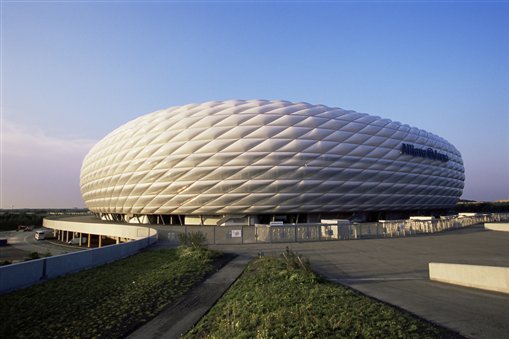
Jan Pitman/Getty ImagesTournaments and International Prestige: Bayern Munich’s Allianz Arena

This January, Bayern Munich revealed plans to increase its Allianz Arena home stadium from its current capacity of 71,137 to 75,000, as reported by ESPNFC.

The expansion plans will only boost Bayern up the stadium capacity ranks in Germany by one position, above Hertha Berlin’s Olympiastadium and behind Borussia Dortmund’s Signal Iduna Park, but Bayern’s ambitions, as we saw from their summer appointment of Pep Guardiola to take over from treble-winning Jupp Heynckes, aren’t limited to domestic triumph.

Consider the stadium’s use planned from the get-go: Since opening in 2005 with one of the most widely recognized exterior stadium designs in world football, it has been the home stadium of both of Munich’s professional football clubs, Bayern Munich and TSV 1860 Munchen, as well as a frequent host of the German national team.

Then there are the finances. In this 2013 article by the Economist, Bayern’s total revenue in 2012 was the fourth highest in the world, after Real Madrid, Barcelona and Manchester United. The nearest challenger from within Germany was Borussia Dortmund with €189.1 million, about half of Bayern’s €368.4 million.

Yes: The same Borussia Dortmund who finished second to Bayern in both the Champions League and the Bundesliga in 2013 had just half the total revenue of Bayern.

Having conquered home soil, Bayern are going after world domination, and with a new stadium, they can place themselves at the forefront of German football—if they weren’t there already.

They have 2020 in their sights. Named as Germany’s candidate city for the 2020 European Championships, which will be taking place across European cities, Munich will be bidding for “Package A,” which includes three group-stage matches and one last-16 or quarterfinal fixture, and “Package B,” which includes both semifinals and the final.

The problem at the moment is that UEFA’s requirements are that stadia must meet 70,000 seats to qualify to host matches in the tournament: As Allianz Arena’s capacity is reduced to 67,812 for international games and UEFA competitions, it currently falls just shy.

Of course, there’s no stadium expansion or corporate super-club that doesn’t have its fair share of commercial deals and strategic alliances: The Economist article quoted above has plenty of coverage of Bayern’s considerable financial might as a result of their sponsorship deals, all the while operating in the Bundesliga context that mandates not more than 49 percent of football clubs can be owned by corporations.

Denis Doyle/Getty ImagesThe Next Level: Real Madrid’s Santiago Bernabeu

For around just £60 million (lower than what Cristiano Ronaldo cost) less than what Arsenal’s Emirates Stadium cost to build, Real Madrid are redeveloping their iconic Santiago Bernabeu stadium for a whopping £328 million (€400 million).

According to the Guardian, Real Madrid president Florentino Perez didn’t mince any words in his proclamations for his club’s goals: “It’s time to face another challenge; we want to make the Santiago Bernabeu the best stadium in the world.”

Currently seating 81,044, the Bernabeu is already one of the biggest in world football, but with the planned redevelopments, according to Marca, it will become the third-largest five-star stadium in the world with 93,000 seats, behind Barcelona’s Camp Nou and the Azteca Stadium.

But it’s not purely about capacity expansion: A quick look at the mockups shown by the Mirror shows the sheer scale of Los Blancos’ ambitions. They will be building an entirely new exterior and adding a retractable roof, in addition to expanding the lucrative VIP areas and corporate box offerings like those at the new Wembley, which Marcasay generate at least €10 million a year alone.

As ever with football stadia these days, the Mirror claim that Real Madrid are looking to negotiate a lucrative naming rights partnership, with Microsoft and Coca-Cola as strong contenders to land a potentially record-breaking deal.

In a league where Real Madrid and Barcelona dominate television revenues due to a lopsided arrangement that earn them about 6.5 times the smallest team in La Liga, according to Bloomberg, despite an impending law that is expected to reduce this inequity, the dominance of Madrid will continue to hold when their redeveloped stadium opens for use.

The politics and implications of reducing the financial duopoly of theel Clasico teams are best left for another article to dissect, but while Madrid may not be able to recoup their eye-watering TV revenues in the short to medium term, their new stadium may provide a very comfortable cushion.

Not that Barcelona will be left behind, though. They’ve already put their own stadium expansion proposal to a vote this April: The upgraded Camp Nou would seat 105,000 fans, surpassing the Azteca Stadium’s capacity and becoming the biggest football stadium in the world. It would cost a whopping €600 million, according to ESPNFC.

The duopoly goes on.

Sharon Latham/Associated PressA Footballing Empire: Manchester City’s Etihad Stadium

Football clubs don’t seem to be content on just winning on the pitch anymore. Our last case study will be on Manchester City, who have caught the eye not just with their achievements in the Premier League and their star-studded squad, but also with their remarkable expansions across the globe.

Their entry into Major League Soccer with New York City FC has already been well-publicized and much anticipated, and just this January they extended their already considerable footballing might into Australia with their acquisition of the A-League’s Melbourne Heart, as reported by the Guardian.

With their tentacles spreading across the globe, City are well and truly building a footballing empire, and right at the middle of this are a few architectural projects back in Manchester.

If Arsenal, Bayern Munich and Real Madrid have all capitalized on their existing fanbases and historical success and catapulted into the 21st-century super-club, Manchester City have broken emphatically into that category in just a few years.

According to the Manchester Evening News, City’s commercial deals in 2012 helped them to increase revenue by 51 percent to become the seventh highest-earning club in the world, behind Arsenal, Chelsea and the aforementioned big three.

Besides City’s well-regarded social media campaigns and money-spinning world tours, they are also going ahead with plans to increase the capacity of their Etihad Stadium from 48,000 to 62,000, which would make it the second-largest stadium in the English top flight and take them into the realm of the European footballing elite.

And just like Florentino Perez of Real Madrid, City’s power brokers have been vocal in their ambitions for their team: Chief operating officer Tom Glick claimed that Manchester would have two of the top-five clubs in terms of worldwide revenues by the end of 2014.

If, as reported by the BBC, the Etihad expansion will be completed by the 2015-2016 season, then City will have with them a mighty financial arsenal in just a couple of seasons’ time. A far cry from its initial capacity of 38,000, and a development fit for an empire.

By that time, however, they might have a new competitor to deal with: Liverpool, who have continued to be a fixture in the top 10 of Deloitte’s Money League for the past few years, despite being the only club there without Champions League football, look ready to return to the European big time.

And, according to the Telegraph, they are planning to submit their own redevelopment proposals for Anfield by the end of the 2013/14 season.


This article first appeared on Bleacher Report, where I contribute regularly on Liverpool and the Premier League.

5 Reasons Brendan Rodgers Deserves a New Contract at Liverpool

With just 12 games to go until the 2013/14 Premier League season ends, Liverpool are fourth in the table and just four points shy of league leaders Chelsea, and Brendan Rodgers deserves major credit for his work steering the Reds towards the top of the table.

According to Jamie Sanderson of the Metro, club owner John W. Henry and his team at the Anfield helm have been suitably impressed by Rodgers’ work and are ready to offer him a new contract to keep him at Liverpool for the foreseeable future.

Just over 18 months into his three-year contract, Rodgers has overseen a transformation in the club’s fortunes but what exactly makes him an ideal candidate to lead the Reds for the next few years yet?

Here are five reasons Brendan Rodgers deserves a new contract at Liverpool. Enjoy, and have your say in the comments below.


Man Management

Man Management
Jon Super/Associated PressLiverpool’s current league position is impressive considering the strength of their immediate competitors but let’s not forget that it could’ve turned out differently had Luis Suarez left the club last summer.

Suarez’s public flirtations with a move to Arsenal and his outspoken desire to play in the Champions League left the Reds at a crossroads: Whether to cash in on their prized asset and use the funds to rebuild—again—or to stick it out and make him adhere to his contract.

On this front, the manager and his bosses stood united: Both Brendan Rodgers and John W. Henry were unanimous in stating that Suarez was to stay and spearhead Liverpool’s Champions League challenge, and so far, it seems to have paid off handsomely.

Rodgers has since admitted, via the Guardian, that the Suarez transfer saga has made him a better manager, but it’s by no means the only managerial feat he’s accomplished in his time at Anfield.

Consider the rejuvenations of Jordan Henderson—which itself has claimed many headlines this season—and Martin Skrtel, from being on the verge of leaving Liverpool to integral parts of the first team.

Consider his impeccable handling of Steven Gerrard’s ageing legs and moving of the legendary club captain to a more withdrawn role to keep his forceful and talismanic presence in the dressing room.

And consider his transforming of Daniel Sturridge, previously a Chelsea castoff, into one of the Premier League’s deadliest strikers, and the growing maturity seen in Suarez’s play.

Brendan Rodgers has proved to be a man who, above all results and points, seems to possess the man-management nous to transform a player’s career and inspire a young and energetic squad.


Youth Development

Youth Development
Sang Tan/Associated PressHand-in-hand with man management comes youth development, and as Raheem Sterling hit two goals against Arsenal in the Premier League last Sunday, Rodgers would’ve been forgiven if he’d felt some sort of vindication for his faith in the youngster all along.

Sterling’s maturation and evolution has perhaps been one of Rodgers’ most noteworthy achievements during his Anfield reign: Catapulted into the spotlight at just 17, he tailed off after the turn of the year in 2013, rested for the majority of the year to prevent burnout and to protect him from media scrutiny amid off-field controversies.

He returned to the fold and has blossomed with a renewed sense of purpose, intelligence and productivity.

But it’s not just Sterling who has benefited from Rodgers’ education and training: The aforementioned Jordan Henderson has grown into a leader in the Reds midfield, while the likes of Suso and Andre Wisdom also made themselves regulars in Rodgers’ Liverpool team last season, while Jon Flanagan’s resurgence has been a heartwarming story for local Liverpool fans.

With Suso and Wisdom out on loan to further their development and promising youngsters like Jordon Ibe and Joao Carlos Teixeira on the way, Rodgers has clearly made Liverpool a haven for young prospects and local talent, which has always been an Anfield tradition.


Economic Sustainability

Economic Sustainability
Jamie McDonald/Getty ImagesBesides investing in youth development, a strong emphasis of John W. Henry’s philosophy and long-term vision for the club, Brendan Rodgers has also worked impressively within the economic sustainability mandate from top management.

The club owners have long cited Arsenal as a model of long-term vision and financial success for Liverpool, and with Rodgers’ work and record in the transfer market, he seems the right person to carry on this overarching mission.

Starting from his first season, where he agreed to release mega-earners Maxi Rodriguez and Dirk Kuyt, Rodgers had already shown that he himself is a fan of sustainable development.

This was exemplified last summer as Liverpool let go of other players on big wages, including Joe Cole, Stewart Downing and Andy Carroll (all, incidentally, to West Ham United), while deciding instead to shift his wage budget towards a bumper new deal for Luis Suarez, signed just this December.

By making use of the loan market—though admittedly with limited success so far—and focusing instead on promising raw talent, Rodgers has kept the team young, refreshed and motivated—and not too taxing on the club’s coffers.


Style of Play

Style of Play
Mike Hewitt/Getty ImagesIt’s one thing to have a grand vision of how things should work and another to actually see it through and implement it.

Anyone who has taken the time to hear Brendan Rodgers talk about his vision and philosophy for football will have been suitably impressed by his mantra and single-minded focus—perhaps even slightly put off by his grandiose terminology.

But while his team took a few months before the message really permeated throughout the club and started showing in their playing style, when the Reds got going in the January of 2013, they suddenly looked a purring attacking machine, firing on all cylinders.

This was helped, of course, by the astute signings of Daniel Sturridge and Philippe Coutinho that month, but with them came goals, possession play and counterattacks of the highest order.

That Liverpool are currently just two goals off the Premier League’s highest-scoring team in Manchester City says plenty about Rodgers’ success in getting his ideals implemented by his team.

And that Arsenal were completely blown away in the first 20 minutes at Anfield last Saturday was a stunning realization of Rodgers’ vision to press, press and press.

A strong togetherness and camaraderie exhibited by the squad this season shows just how united Rodgers has built his team to be. They’ll have been drilled and driven to go relentlessly at opponents to attack and score—and most importantly, enjoy their football.


Overachieving Results

Overachieving Results
Paul Gilham/Getty ImagesAfter a disappointing league finish last season, Liverpool fans had at least witnessed the potential of a young Reds team going at full steam in the last few months.

But to envision a strong top-four challenge—not to mention being just a few points of the top of the tree in mid-February—was surely always going to be a step too far in Brendan Rodgers’ second season at the helm.

But not only has Rodgers gotten Liverpool to their current position—and top of the league on Christmas Day—he’s produced some eye-opening and jaw-dropping results along the way.

Regular four-goal hauls in the league no longer surprise, but they are relished. Tottenham Hotspur were handed a 5-0 beating at White Hart Lane, while Liverpool disposed of Everton 4-0 in the 222nd Merseyside derby and hammered Arsenal 5-1.

This season has already been an overachievement and as Rodgers inches ever closer to the Holy Grail that is the Champions League, he is at least deserving of a bonus as recognition of his impressive achievements.

This article first appeared on Bleacher Report, where I contribute regularly on Liverpool and the Premier League.

The World Cup: Evolution from Celebration of Football to Money-Making Exercise

“No decision will be taken before the upcoming 2014 FIFA World Cup Brazil, as agreed by the FIFA executive committee.”

Source? An official FIFA statement, via the Guardian. Topic? Whether the 2022 World Cup in Qatar will be held in the summer or winter, of course; it’s only been the topic that’s consumed most international football fans and FIFA observers in the past few months.

The timing though? Immediately after Jerome Valcke, the FIFA secretary general, suggested to a French radio station that the World Cup might be moved to November 2022 after all.

Confused? You’re not the only one. But what’s been made apparent from the Qatar World Cup 2022 debacle, is that besides all the confusion and suspicions, the focus has firmly been taken away from what the World Cup is supposed to celebrate: football, the game itself.

Sure, the talk has revolved around Qatar’s temperatures in the summer, which would make for harsh conditions for players and fans alike, but surely that would’ve been a factor in the decision-making process leading up to awarding Qatar the host rights, instead of a topic to be discussed afterwards.

That Sepp Blatter and FIFA want to bring the World Cup to the Middle East is not a secret: Back in November, he even entertained the idea of hosting the tournament across several countries in the Gulf region, according to the Telegraph. So the globalization of football and the expansion of FIFA are two key items on the agenda, and both politics and money are equally prominent at the heart of all this, as we studied in an earlier article on the World Cup controversies.

But how exactly did the World Cup get to this current state? To answer that question, let’s go back and trace the evolution of the world’s most prestigious tournament from celebration of football to money-making exercise.

Laurence Griffiths/Getty Images

The Olympics: Eternal Rival and…Founding Father?

To understand the World Cup’s evolution and growth, we must first consider the history of the Olympic Games, eternally seen as the World Cup’s rival tournament in terms of global reach and prestige.

The distinction is always made that the Olympics celebrate not just one sport, but sport as man’s pastime, while the World Cup is only the gathering of footballing nations in the world—and before the United States’ entry and strong showing, not even encompassing the entire world. The World Cup’s proponents point to the final as the premier spectacle in world sport, with no single sporting match able to match its global appeal.

In reality, while they might be rivals now and trying to outdo each other every two years, it didn’t start out that way. In fact, the World Cup has the Olympics to thank for its current iteration and success, because it was the Olympics that gave birth to the World Cup as we know it.

When FIFA was founded in 1904, international football—indeed, professional football—was a phenomenon only affordable for a few countries, and when football was inducted into the Olympic Games in the summer of 1908, only amateurs were represented. Any attempt at organizing a truly international football tournament was undermined by the lack of professional setups in most countries around the world.

But when Uruguay won both the Olympic football tournaments in 1924 and 1928, FIFA, with then president Jules Rimet as a visionary driving force, stood up, took notice, and most importantly, set about realizing his dream. The first FIFA World Cup was to be staged in 1930 in Uruguay, with politics—what else?—at the heart of the host location decision: It was to be the 100th anniversary of Uruguay’s independence, and it was to be made not a great celebration of the game itself, but a spectacular political statement.

How else to explain it, given that the Uruguay national football association was willing to cover all travel and accommodation costs incurred by participating teams? As even FIFA.com concedes, that possible profits would be shared with participants and deficits taken on by the host country won Uruguay the first ever World Cup hosting rights.

The 1934 competition was held in fascist Italy under the dictatorship of Benito Mussolini, and Rimet, according to this excellent Independent feature on his life, was already criticized for politicizing football.

Before the advent of television and the phenomenon of globalization, the World Cup had surrounded itself with politics and money.

(A footnote to add, though, is that Jules Rimet’s vision and dream of uniting the world through sport and creation of the World Cup earned him a Nobel Peace Prize nomination in 1956. Perhaps, hopefully, the World Cup at its heart was actually more than a celebration of the beautiful game, but a triumph of humanity.)

Carlos Alvarez/Getty Images

The Context: Globalization and Technology

But just as we can’t give the Olympics all the credit for introducing the concept of a FIFA World Cup, so Rimet and FIFA can’t claim all the glory for growing the tournament from a small competition featuring just a few countries in Montevideo, Uruguay, to the global spectacle that was the 2010 World Cup in South Africa.

As ever, context is key, and the explosion of global business and trade, just as it’s played a huge role in the history of the 1900s, is an integral part of the World Cup’s continued evolution. Before the business side of things took over, though, first came the phenomenon of television.

According to this TIME feature, the impact of television on the World Cup’s boom cannot be understated: From 1954 to 1986, the number of TV sets worldwide “increased more than twentyfold, from a little more than 30 million to more than 650 million.” This laid the foundations for a truly groundbreaking moment in football history.

The first live World Cup games were broadcast in Europe in the 1954 tournament, which reached only a handful of audiences due to the low volume of matches shown, but the potential of television and TV advertising was already apparent. (Not that the Olympics were to be beaten, of course: The 1936 Summer Olympics were the first to be broadcast on TV to local audiences. International broadcasts came in 1956.)

Fast forward a decade and a half. Spying an opportunity to conquer the world of football and reap the ensuing economic benefits in 1974, was new FIFA president Joao Havelange, who upon taking office turned his organization into a modern international NGO, putting in place the infrastructure, people and income-centered mindset of a corporation.

The only thing left to do for the World Cup, which previously featured 16 national teams, was to expand. And expand Havelange did, opening the doors to developing countries with eight additional slots (which have since been further increased to a total of 32 participants since France 1998), as discussed by Tim Vickery for The World Game. The Havelange era also saw the introduction of the FIFA U-17 World Cup, FIFA U-20 World Cup, FIFA Confederations Cup and FIFA Women’s World Cup.

The costs of hosting such an immense global tournament in one country were too much to bear for one host country and FIFA, and thus came the idea of corporate sponsorship of the World Cup. Havelange struck deals with Horst Dassler, heir to the Adidas fortune, for the German sportswear company and other big-name corporations like Coca-Cola to fund the tournament, paving the way for the commercialization of international football.

So while the advent of television advertising led to increased premiums for marketers to get their spots onto World Cup TV screens, behind the scenes within FIFA itself was a concerted movement to pump money into the World Cup—with political and economic influence once again the main motivation behind all these changes.

(The name Joao Havelange may be familiar. He was the same FIFA ex-president that resigned in April 2013 after a FIFA ethics report ruled that he had taken bribes, as reported by BBC Sport. The culprit in question? International Sport and Leisure [ISL], founded by Horst Dassler. Politics and money, indeed.)

Getty Images/Getty Images

The 1990s and Onwards: Spiraling Out of Control

If ever there was a curious decision in the history of world sport, the idea to host the 1994 World Cup in the US was clearly one, at the time. In hindsight, however, it was just another calculated plan from Havelange to bring the game to North American shores, which had yet to be consumed by football fever.

The legacy was stunning: To this date, USA 1994 still holds the total attendance record (over 3.5 million) and the average attendance record (68,991), according to USSoccer.com. The US’s advancement to the round of 16 for the first time since 1930 contributed to soaring TV ratings.

(Leading up to its hosting of the World Cup, the US also put in place their first ever professional soccer league. It’s no surprise that Major League Soccer was founded in 1993, a year before the 1994 World Cup. We explore the growth of soccer in the US in another article.)

The introduction of the World Cup in practically uncharted territory in 1994 was met with enormous financial successes, and since its foray into the world leader of commercialized sport and corporate sponsorship, FIFA have never looked back. The World Cup has since traveled to Asia (2002) and Africa (2010), goes to Russia in 2018, and brings us to the Middle East in 2022.

According to this Economist article, the World Cup broadcasting rights for France ’98 were sold by FIFA in 1987, before the stunning 1994 American success, for $344 million. An indication of how far the World Cup and FIFA have gone: In 1998, at the time of the article, ISL—which would later collapse, of course—had agreed to pay $2.2 billion to show the games outside America.

The groundwork for corporate sponsorship was laid by Havelange, but was taken to new levels under the leadership of current president Sepp Blatter. Let’s consider the 2010 World Cup, for example: According to a UPenn study, FIFA’s revenues related to the South Africa tournament amounted to a staggering $1.022 billion, of which $650 million belonged to broadcasting rights.

Participating national teams are in on the act too: FIFA was to provide $420 million to all participants and the football league teams providing players to the national teams, $30 million of which would go to the World Cup-winning team (Spain). First-round teams qualified automatically for $8 million each, while $1 million in preparation costs were provided to each participating football association.

This was brought about by the stellar line-up of corporate FIFA sponsors, known as “partners,” which included Adidas, Coca-Cola, Emirates Airlines, Hyundai-Kia Motors, Sony and Visa, who were “guaranteed exposure in the tournament stadium” and would receive “direct advertising and promotional opportunities and preferential access to TV advertising.”

The cost? A minimum of between 100 and million euros through to 2014. By which time, of course, the next World Cup cash cow will be held this summer, this time in Brazil.

Clive Mason/Getty Images

Conclusion: It’ll Only Get More Expensive From Here

Is it damning or merely inevitable that corporate sponsorship and incessant marketing efforts are now part and parcel of any World Cup?

In the build-up to this summer’s tournament, the allegations of corruption have been brushed aside after Havelange’s resignation in 2013, while all the talk of political and commercial interests have been directed towards the distant 2022 World Cup in Qatar, still eight years away.

It’s no longer news—rather, it’s an accepted fact—that the World Cup is now considered an extremely lucrative opportunity for brands and nations alike; this Fox article on Nike and Adidas’ brand battle pre-World Cup is now just part of the fabric. In fact, any sports company—or indeed any business entity at all—would be condemned for not taking advantage of a World Cup year to promote its business.

And so it’s only going to get more expensive from here. The spending and rights associated with the premier world football tournament have skyrocketed in the past decade or so, with the help and under the influence of a few key players, but the brand-new stadiums that are to be constructed in host countries are just the tip of the iceberg when it comes to World Cup spending.

But it’s the World Cup. Just as FIFA continue to rake in the cash, we football fans will continue to ignore the commercial influences and political battles and focus on the spectacle that will unfold before our eyes when the first whistle is blown on June 12 at the Arena de Sao Paulo.

An event of this magnitude only comes once every four years, after all. When the winning team hoists the Jules Rimet trophy on July 13, for once the celebrations will be directed entirely towards the football that they have played, not the money they will make.

This article first appeared on Bleacher Report, where I contribute regularly on Liverpool and the Premier League, and at times on the business of football.

Why Liverpool’s Jordan Henderson, Raheem Sterling Should Go to the World Cup

In light of the unfortunate news of Theo Walcott’s long-term injury, sustained in Arsenal’s 2-0 defeat of Tottenham Hotspur in the FA Cup and effectively ruling him out of the World Cup, as reported by BBC Sport, Roy Hodgson could be forgiven for feeling just a bit worried.

With Walcott out of contention and Jermain Defoe supposedly nearing a move to MLS’ Toronto FC, according to Sky Sports, the most experienced English forward Hodgson has at his disposal after Wayne Rooney is fellow Manchester United striker Danny Welbeck, on 20 caps.

Other options available for selection include Liverpool’s Daniel Sturridge (nine caps) and Southampton’s Rickie Lambert (four): not the most experienced or deepest forward line in England history by any stretch of the imagination.

The good news, however, is that England can make up for their shortage up front by strengthening their midfield and wings. A healthy mix of experience and youth in the midfield would now be grateful for an injection of quality ahead of the World Cup.

Step forward Liverpool’s Jordan Henderson and Raheem Sterling, who would provide just that. Here are five reasons they should make it into Roy Hodgson’s squad that will be heading to Brazil this summer.


Deserved Reward for Improvement

Hi-res-456856459-jordan-henderson-of-liverpool-celebrates-scoring-their_crop_650
Paul Gilham/Getty ImagesAsk any Liverpool fan about their best player this season, and second to Luis Suarez, who will deservedly take the plaudits from his scintillating record thus far, will be Jordan Henderson, who has been ever-present in Brendan Rodgers’ first team.

It wasn’t too long ago that Henderson was being written off as a £16 million flop, following a couple of indifferent seasons after his switch from Sunderland. That Rodgers was about to send him off to Fulham in the summer of 2012 is well-known; that Henderson has bounced back from all these setbacks is just as impressive.

Not only has Henderson finally found the confidence and form of his Sunderland days, but he’s seemingly added to his arsenal as well. Besides his legendary work rate and positional discipline, he’s added a touch of flair to his game as well: His back-heels, crosses and incisive passing have been a crucial element to the Reds’ final third; a record of five assists in 20 games thus far already betters his tally (four) last term.

The same applies to Raheem Sterling, who, besides storming back to the form he showed in the first few months of his debut season, has added a maturing awareness and clinicality to his game. Three goals and two assists in just nine starts this season is an impressive record for the young winger, still only 19.

In an England team short of full quality, what better than to reward these two up-and-coming talents with a place on the World Cup squad? Their development this season is evident; if they continue their rise in form and improve on their shortcomings—finishing is definitely on the agenda—then there’s no reason they wouldn’t be able to make an impact in Brazil.


Youth, Energy and a Different Dimension

Hi-res-454133545-raheem-sterling-of-liverpool-competes-with-mohamed_crop_650
Clive Brunskill/Getty ImagesHere are a few of England’s regular midfielders and wingers: Steven Gerrard (captain), Frank Lampard, Michael Carrick, James Milner, Ashley Young. Others, like Tom Cleverley, Jack Wilshere and especially Adam Lallana and Andros Townsend are relative novices to the international scene.

The problem with the first-choice midfield, as we saw at Euro 2012, is that it’s not bursting at the seams with pace and stamina. Sure, Gerrard, Lampard and Carrick are all capable of dictating play from deep, and the former two are of course known for their ability to go forward and get themselves a goal, but it’s a midfield that can be caught out of position and brushed aside quite easily.

As evidenced by England’s recent international games, Roy Hodgson also recognizes the need to move away from the traditional two banks of four in a 4-4-2 system, which can easily be exploited by teams with powerful and quick midfields: Italy, Uruguay and Costa Rica will pose an interesting challenge.

Even out on the wing, though he can also operate centrally, James Milner is not the fastest of players, and as such, he doesn’t offer as much of a cutting edge as Hodgson would like—even though his all-round contributions are important.

With the introduction of Henderson and Sterling, England would get two players with the pace and stamina to both pressure and hurt teams. While in Gerrard and Lampard, England possess two world-class set-piece specialists, adding youth, energy and pace that would allow the Three Lions to develop other areas of their game.

On a potential counterattack, which England should surely take full advantage of given their pacy forwards in Rooney and Sturridge, having a midfield runner like Henderson carry the ball on the floor, and having another winger like Sterling to break open the defence, would be valuable assets in Hodgson’s disposal.


Contributions to Overall Play


Hi-res-456857061-jordan-henderson-of-liverpool-is-marked-by-mousa_crop_650
Paul Gilham/Getty ImagesWhen it comes to the midfield area, an especially useful description these days is “complete.”

Predominantly defensive midfielders should be capable of nicking a goal here and there, and attack-minded ones should also be able to track back and do some of the dog work to alleviate pressure off his team.

While Young and Townsend are known for their relative speed, they also don’t do quite as much work for the team defensively and thus may be prone to leaving gaps out wide, leaving defensive burdens for England’s full-backs. Gerrard and Lampard have shown signs of their age catching up to them this season, and their forays forward may leave holes in the central area that opponents can exploit on the break.

It is here that Henderson and Sterling step in and offer their impressive blend of athleticism, technique and defensive work. Often played as the furthest forward midfielder in Brendan Rodgers’ setup, Henderson has been a fine second line of defence (after the excellent Suarez and his harrying up front), while Sterling has exhibited on many occasions this season his willingness to track back and an underrated tackling ability.

Add their potential contributions in attack (especially Sterling, with his well-timed runs in behind opposing defences), and they represent two fine all-round attacking players that would make for a well-balanced team. Milner and Wilshere also fit the mold and would be perfect partners in an interchangeable, dynamic midfield unit.


The Liverpool Connection

Hi-res-175375234-jordan-henderson-of-liverpool-is-congratulated-by_crop_650
Clive Brunskill/Getty ImagesIn the summer of 2012, Roy Hodgson was widely ridiculed for his supposed preference for Liverpool players. After all, in his squad of 23, he included six Reds, and the likes of Stewart Downing, Andy Carroll and Jordan Henderson hadn’t enjoyed the best of seasons at Anfield.

This time around, though, it’s completely different. While Glen Johnson hasn’t enjoyed the best of seasons down Liverpool’s right, he should make the plane to Brazil barring any extraordinary circumstance. Otherwise, Steven Gerrard is the England captain and Daniel Sturridge one of their newest striking hopes.

So the Liverpool contingent in the England squad will likely be used heavily in Brazil, which makes Henderson and Sterling potentially important additions to the team.

Henderson’s partnership with Gerrard this season has caught the eye: The way Henderson has assumed Gerrard’s famed lung-busting and swashbuckling attacking midfield play, and the ease with which the Liverpool captain has assumed his registaduties, harks back to the famous Gerrard-Xabi Alonso partnership during Rafael Benitez’s halcyon days.

Sterling’s combination play with Johnson down the Reds’ right flank will also come in handy, while Henderson and Gerrard will have been used to Sterling’s runs off the shoulders of the last defender. It remains to be seen how Brendan Rodgers will juggle his attacking line once Sturridge returns to full fitness, but Sterling should also have plenty of chances to dovetail with Sturridge in the coming months.


Ushering in a New Golden Generation

Hi-res-450589911-danny-ings-of-england-celebrates-scoring-his-sides_crop_650
Michael Steele/Getty ImagesWhen the tag “Golden Generation” is mentioned in the context of the English national team, most reactions are of disappointment and frustration, such is the extent to which the current crop underwhelmed in major tournaments.

But it’s not that the term itself has any negative connotations—far from it. In fact, when the right infrastructure is put in place to groom a generation, it may well provide the platform from which to grow said “golden” era. The likes of Spain and Germany, not to mention many European club teams now, are living examples of such long-term thinking.

As Hodgson and England prepare for the swansongs of Gerrard and Lampard and usher out the old guard, so the new generation comes in and looks for ways to grow as a collective unit. And what better than to start with the World Cup?

Alongside the likes of Jack Wilshere, Adam Lallana, Daniel Sturridge, Danny Welbeck and Ross Barkley (among others), Henderson and Sterling are in prime position to cement themselves as England regulars in the coming years as they continue to mature in international tournaments to come.

While England must look immediately at doing as best as they can in the World Cup, Hodgson would do well to start immersing some of his young, precocious talent in preparation for future competitions. If there’s anything we’ve learned from Jordan Henderson and Raheem Sterling this season, it’s that they certainly won’t let their manager down.


This article first appeared on Bleacher Report, where I contribute regularly on Liverpool and the Premier League.

A Comprehensive Half-Term Report on Liverpool’s 2013/14 Premier League Season

After their 2-0 home win over Hull City to start the New Year off with three points, Liverpool are now fourth in the Premier League table with 39 points from 20 games, and just over halfway into their quest for a return back to the Champions League.

All told, it’s been an encouraging season for Brendan Rodgers’ men so far, and with the prolific Luis Suarez in their ranks, the Anfield side currently boast the second highest goal difference in England’s top flight with +23 (46 scored, 23 conceded).

Most Reds fans—indeed, probably including the Liverpool management and players—would have taken fourth in the league at the start of 2014 if it could’ve been offered to them at the start of the season, yet how do they stand for the rest of the season?

In the following 10 slides you’ll find a comprehensive half-term report on Liverpool’s season halfway into the 2013/14 Premier League campaign, where we’ll assess different aspects of the club’s performance thus far, before arriving at a prediction on how far the Reds can go this season.

Enjoy, and give us your take in the comments below.


Formation and Playing Style

Hi-res-185923742-liverpool-manager-brendan-rodgers-issues-instructions_crop_650
Clive Brunskill/Getty ImagesBrendan Rodgers came to Liverpool in the summer of 2012 with a well-known fondness for a 4-3-3 formation favoring quick, short passes and constant movement of the ball. His Liverpool team showed unfamiliarity with his new methods and thus got the 2012/13 season off to a slow start.

A year on, his team roared to a perfect start to their Premier League campaign in a more familiar 4-2-3-1 formation, with Daniel Sturridge leading the line as lone striker in Luis Suarez’s continued absence due to suspension. Sturridge was to score his side’s first three goals of the season in three consecutive 1-0 wins.

Those three victories over Stoke City, Aston Villa and Manchester United were achieved in stark contrast to Rodgers’ slick possession-dominant style, as they reverted to defence first in the second halves and ground out the wins. A case of warming up to the new season, perhaps, but the Reds have only achieved three clean sheets in the league since then.

As Suarez returned in brilliant form, Rodgers encountered a selection dilemma, and eventually opted for a 3-5-2 to accommodate his free-scoring strikers and also take advantage of his strength in numbers in central defence.

Right when this surprise 3-5-2 formation was suggested as the Liverpool way of the future, Daniel Sturridge got injured, leading Rodgers to switch back to his favored 4-3-3, with Philippe Coutinho and Raheem Sterling flanking Suarez as the central striker. This was the start of a scintillating personal campaign for Suarez that has seen the No. 7 score 20 goals in just 15 league games thus far, in the process becoming the fastest player to hit the 20-goal mark.

All this was achieved with a new withdrawn regista role for Steven Gerrard, who played alongside Lucas and provided a newly revitalized Jordan Henderson with the platform to charge forward. New signings Iago Aspas and Victor Moses both tried and failed the No. 10 role, while Coutinho has taken up a place on the left cutting in to support Suarez.

Gerrard’s relatively pedestrian contribution in the side could have been considered an antithesis to Rodgers’ all-action style, but his long balls and set-piece delivery in turn led to goals in every manner possible: Liverpool, having picked up a reputation for being weak defending set pieces, also became known for their goal-scoring prowess from free kicks and corners. (Luis Suarez’s deadly finishing from free kicks outside the box also contributed.)

When Gerrard himself was injured in the beginning of December and Joe Allen was fit enough to return to the starting XI, Liverpool began to transform into something more akin to a Rodgers staple. A midfield trio of Lucas, Henderson and Allen, while remaining in the 4-3-3 formation, pressed and harried opponents into losing possession, thereby sticking to Rodgers’ “death by football” mantra, and looks to be Liverpool’s image in the medium to long term, especially when Gerrard eventually calls time on his career.

In just six months at Anfield, we witnessed transformations and progress in Liverpool’s tactical setup and playing style while the points continued to be picked up. We’ll have more on each area of the field and Liverpool’s progress from last season in the coming slides.


Transfers

Hi-res-459490657-simon-mignolet-goalkeeper-of-liverpool-celebrates-the_crop_650
Jan Kruger/Getty ImagesFor players who joined the club in the summer, find our grades and analyses on how they’ve done in their first six months at Anfield in our guide here, where we assess them on value for money, impact and potential.

We’ll cover most of the first-team players in the following few slides focusing on the Liverpool defence, midfield and attack.


Defence

Hi-res-459716489-martin-skrtel-of-liverpool-celebrates-with-teammates_crop_650
Clive Rose/Getty ImagesOne of the stories of Liverpool’s season thus far is the return to prominence of Martin Skrtel—if prominence can be measured by first-team starts.

Since his return against Manchester United early in the season, Skrtel has been a fixture in Brendan Rodgers’ starting XI, having made 18 appearances this season already with two goals to his name.

While he enjoyed a resurgence in form for a few months, in recent weeks he has committed a number of defensive errors—not least in the buildup to Samuel Eto’o’s winning goal against Chelsea on December 29—that have largely been glossed over. Questions will continue to arise of his blatant shirt-pulling in the box, as well as of the relative lack in vocal leadership and on-field organization when Skrtel is playing.

Alongside Skrtel, Daniel Agger and Mamadou Sakho have taken turns as Rodgers’ starting left-sided centre-back with mixed results, as Agger—despite having been awarded the vice-captaincy in the summer after Jamie Carragher’s retirement—hasn’t been able to find the consistency and form that previously made him an Anfield icon.

Sakho, on the other hand, established himself as first choice over Agger prior to his hamstring injury sustained at Stamford Bridge. In Sakho’s absence over the coming few weeks, however, Agger will have a chance to reestablish his place in the starting line-up. If he manages to sustain his performance against Hull City on New Year’s Day, Rodgers may well have more to think about when Sakho returns.

On the right flank, Glen Johnson has been ever-present, but sadly out of sorts at the moment, having put in a series of lethargic and uninspiring performances in recent weeks. A lack of genuine competition in the right-back slot hasn’t helped, but Rodgers will surely continue to look at Martin Kelly’s fitness and form to see when would be a good time to reintroduce him for some much needed competition to Johnson.

Jose Enrique had started to enjoy an improvement in his form at left-back before he was ruled out with a lengthy injury layoff in November. Jon Flanagan, a right-back by trade, came into the side after on-loan Aly Cissokho failed to assert himself, and the academy graduate grabbed the headlines with a standout performance in the Merseyside derby and an exciting first-ever senior goal in the 5-0 rout of Tottenham Hotspur. Cissokho’s decent display against Hull after Flanagan himself was injured will have been encouraging—and a relief.

Overall, Liverpool’s defensive record this season speaks for itself: A total of 23 goals conceded, just over a goal a game—with just six clean sheets—is not good enough, though an all-conquering strikeforce has rendered it a lesser concern for the time being.

Their proneness to concede from set pieces, as well as questioning positioning on counter-attacks—not helped by a gaping central midfield hole—will be two key defensive issues for Rodgers and his backroom team to iron out for the second half of the season.


Midfield

Hi-res-185345517-steven-gerrard-of-liverpool-celebrates-scoring-his_crop_650
Paul Thomas/Getty ImagesAh, the midfield—so important to the Rodgers philosophy and Liverpool’s style of play.

Before we elaborate further, we must first recognize the work and rise of Jordan Henderson at Liverpool Football Club. Just a year ago, Henderson had the choice of continuing his career at Fulham or fighting for his career at Anfield. He picked the latter, and Rodgers has been impressed enough to give him almost a permanent starting spot in his first XI.

Put simply, Henderson has blossomed. There is a newfound confidence, a refreshing swagger in his play, while he has been able to put his incredible work rate to good use in pressuring and harrying his opponents.

His passing has been positive, and his running in the advanced midfield position has been direct and threatening. If he adds the finish and the final ball to his game, Liverpool fans may finally forgive his £16 million price tag.

Alongside Henderson, another midfielder to flourish recently is Joe Allen, who is enjoying a new lease of life in his “second stint” at Anfield, if we can call it that after a lengthy injury layoff following a mixed half-season last year.

Having returned to the line-up after Gerrard’s own injury, Allen has upped his game considerably following a painful miss at Goodison Park and has become an integral part of the dynamic, interchanging midfield now delighting fans week in, week out.

And like Henderson, Allen needs to work on his composure in front of goal. As the midfield unit progressively moves forward on each attack, every midfielder has a chance to break through and arrive in the box. They need to take their goal-scoring chances.

Further back, Steven Gerrard and Lucas have had mixed seasons thus far. A common criticism leveled at the Reds this season is that their midfield has the tendency to implode against quick and powerful opponents, as was evidenced against Southampton, Arsenal and Chelsea. Both Gerrard and Lucas do not have the legs or the positional awareness to hold the midfield, and thus the central areas are badly exposed, especially against counterattacks.

Gerrard has contributed three goals and six assists in his 16 Premier League appearances this season, which suggests that he still has a big part to play at his club, but may not be a good fit in the Liverpool blueprint going forward. Lucas, meanwhile, may find his importance diminished and first-team status affected if Rodgers does sign a defensive midfielder in January.

In the first half of the 2013/14 season, we’ve seen a few different identities, as we laid out in the first slide on formation and playing style. The changes and variances are all anchored in and affected by the midfield: Gerrard’s presence allows for a more varied approach but with more potential to be overwhelmed, while the recent Lucas-Allen-Henderson combination gives Liverpool a more relentless image.

It will be interesting to see when Rodgers decides to use which option when all of his charges are back to full fitness.


Attack

Hi-res-459415699-luis-suarez-and-raheem-sterling-of-liverpool_crop_650
Alex Livesey/Getty ImagesIt would be fairer to start this section with Daniel Sturridge, who got Liverpool through the first couple of months of the season, but 2013/14 at Anfield has been all about one man: Luis Suarez.

Suarez, having publicly flirted with an exit from the club in the summer, was forced to buckle down, and buckle down he has. Not only that: He’s improved on almost every aspect of his play and seemingly on his attitude as well. A devastating improvement on his finishing has seen him rocket towards the summit of the Premier League scoring charts, setting records along the way.

In addition to becoming one of the most feared strikers in the world, Suarez has also kept his hardworking style, which makes him Liverpool’s defender from the front and an important component of a relentless, pressing unit. It’s just as well that they managed to sign him on a new and improved contract extension in December.

But before Suarez came back with aplomb, Sturridge was the one carrying the Liverpool team. With nine goals and two assists in just 12 league games, Sturridge has enjoyed a fruitful season as well, carrying on his form from last season—just not as stellar and exhilarating as Suarez.

A rapidly maturing striker in his own right, Sturridge will likely return to first-team action in January, giving Rodgers a tactical dilemma and opponents all the more reason to fear the Reds.

But Liverpool fans had been looking forward to Sturridge’s return since the confirmation of his injury layoff, so why would it give Rodgers a dilemma? The answer lies in Raheem Sterling, who has come back into the first team and showed signs of continued development and growth with a series of exciting displays on the right of the frontline.

Sterling’s pace, trickery and direct running have caused opponents all sorts of problems since his own return to the first team, and his three goals in 15 appearances show that he is starting to add the final touch to his impressively all-rounded game, something that fellow attacker Philippe Coutinho also needs to work on.

It was always going to be hard for Coutinho to reprise his excellent first half-season at Anfield after signing for Liverpool last January, as opponents would have had six months to figure him out. With that said, while he has shown the vision, creativity and pace that were so threatening last season, he has yet to hit the same heights. A paltry sum of two goals and two assists this season sums up his difficulties, though he has largely been played on the left instead of in his favored No. 10 position.

With the league’s second most prolific scoring record, Liverpool have other areas than their forward line to worry about for the rest of the season. Their existing attacking setup will continue to deliver.


Strengths

Hi-res-183158436-steven-gerrard-of-liverpool-takes-a-corner-during-the_crop_650
Clive Brunskill/Getty ImagesSo with the lengthy summaries of each on-field department now covered, let’s move towards Liverpool’s strengths in their first six months of the season.

Without a doubt, Liverpool’s set piece mastery needs to be mentioned. For a team that struggles so regularly in defending set pieces, their prowess attacking form is surprising and quite extraordinary. Nonetheless, all three of their regular starting central defenders—and, of course, Suarez and Sturridge—have scored from set pieces, largely due to the world-class deliveries of Steven Gerrard.

The evolution in Liverpool’s approach play also deserves a mention here, as they have started to dominate games completely and blow away their opponents: Their “goals scored” column is so emphatic because they have really honed their craft going forward this season. They have now scored 87 goals in their past 38 league games, 10 more than their highest-scoring full season in the Premier League era.

A product—or perhaps the foundation—of such fearsome attacking play is their excellent home record this season. Anfield has well and truly regained its “Fortress” moniker, as the Reds have stormed to nine wins out of 10 at home this season, scoring 27 goals and conceding just six in the process. Their 27 points from a possible 30 at home this season is just behind Manchester City (30/30) and Chelsea (28/30).

Finally, we must devote some column space to the youngsters at Rodgers’ disposal: A young goalkeeper in Simon Mignolet and a future star in Mamadou Sakho; the pace, industry and massive improvement of Jordan Henderson and Raheem Sterling; and the undoubted quality in Philippe Coutinho and Daniel Sturridge. This is a squad whose full potential lies ahead of them and whose young age needs to be regarded as a strong asset.


Weaknesses

Hi-res-451548293-joe-allen-of-liverpool-misses-a-chance-on-goal-during_crop_650
Alex Livesey/Getty ImagesThere have been a few weaknesses of note evident in their season thus far, however.

Just as we started our coverage on Liverpool’s strengths with their set piece prowess, so we must highlight their vulnerability at defending set pieces and crosses into the box. The unconvincing defending and unsure positioning in such situations have caused panic to spread among supporters and manager alike in those situations—Rodgers had already outlined his concerns back in October, according to the Liverpool Echo.

We’ve touched on this in our slide on the midfield as well, but it bears repeating here: The gaps that open in the midfield area due to positional errors, pedestrian pace and a lack of specialist defensive midfielders can hurt Liverpool badly, especially on the counterattack.

Steven Gerrard’s return from injury may be a double-edged sword and must be managed carefully by Rodgers, who has seen a revolution in his midfield performances during the captain’s absence.

For a side that possesses such a fearsome scoring record and frontline, Liverpool could do with further improvement in their finishing across the squad. While this obviously doesn’t apply to Suarez and Sturridge, the rest of the team needs major work in this area.

Allen, Henderson, Coutinho and Sterling have all missed absolute sitters this season. It’s tempting to think where Liverpool would be at now, especially in terms of goal difference, had they scored at least some of them.


Results

Hi-res-452758835-luis-suarez-of-liverpool-looks-dejected-as-he-falls-to_crop_650
Jamie McDonald/Getty ImagesOn to results, an area that has seen a massive improvement over last season, largely because of the improvement in Liverpool’s attack.

A prolific stretch that started in October and lasted all the way through December saw the Reds score 23 goals in just six home games, while a five-goal hammering of Tottenham on December 4 will go down as one of their best Premier League performances of all time.

It’s not for no reason that Liverpool finish round 20 in fourth place: They’ve simply outplayed opposition they’ve needed to beat and regained that useful habit of picking up points in winnable games on paper. An overall record of 12 wins, three draws and five losses in 20 games—including a few major refereeing controversies—is more than admirable.

So it is on those five losses that we will focus, but the surprising thing—and the silver lining—is that they can easily be remedied.

We’ve mentioned the Southampton and Arsenal losses in previous sections; hopefully further reinforcement to Liverpool’s midfield down the line will improve their record against teams strong in the middle of the park.

Lee Mason and Howard Webb’s officiating against Manchester City and Chelsea respectively drew widespread criticism from both Rodgers himself and the media at large. While Liverpool’s performance at Stamford Bridge wasn’t quite up to scratch—again, the midfield was at issue—their excellent display at the Etihad Stadium should have yielded at least a point, but for the referee’s whistle.

Which leaves the defeat to Steve Bruce’s Hull City, at the KC Stadium on December 1, as perhaps the lone outlier. The simple explanation is that Bruce’s side enjoyed a fine result and Rodgers’ men had an off day, and it wouldn’t be too far off as Liverpool just didn’t turn up for the match. A disappointing day out for the Reds, which fortunately hasn’t been replicated for the remaining matches until this point.

Liverpool quite clearly need further strengthening to their ranks, starting from this January, but their results thus far have highlighted areas they need to reinforce. Targeting those improvement needs should be able to bring about improved results for the remaining 18 games.


Progress from Last Season

Hi-res-176676967-daniel-sturridge-of-liverpool-is-congratulated-by-iago_crop_650
Clive Brunskill/Getty ImagesTo gauge Liverpool’s position at the halfway point of the 2013/14 season, besides evaluating it against their immediate rivals and in the context of just the past six months, a useful barometer would be where they stood this time last season.

On New Year’s Day 2013, with 20 league games played, Liverpool found themselves in 10th place on just 28 points, with a goal difference of +5. A quick comparison to their current picture (fourth, 39 points, GD +23) shows just how far they’ve come in the past year.

Brendan Rodgers deserves massive credit for this turnaround in results, as does the transfer committee for securing two of Liverpool’s most exciting transfer signings in recent history last January in Coutinho and Sturridge, who have been instrumental in the Reds’ growth this calendar year.

Keeping Suarez in the summer was perhaps more important than any signing they would’ve been able to make, as he’s almost singlehandedly fired Liverpool to their lofty position this season, but even besides the impressive increase in goals scored, the maturity in their overall play—particularly in recent weeks with Rodgers’ blueprint midfield—has been evident.

No wonder they’re mulling a new contract extension for Rodgers himself (c/o Mirror).


Potential and Prediction for the Season

Hi-res-179184723-liverpool-manager-brendan-rodgers-gestures-during-the_crop_650
Alex Livesey/Getty ImagesWith a side capable of switching formations at will and changing attacking approaches when required, Brendan Rodgers has at his disposal a flexible, versatile and well-drilled unit that has the world at their feet and their best years ahead of it.

The key is to unlock his squad’s potential at the earliest opportunity possible, as this unpredictable and topsy-turvy 2013/14 Premier League season represents perhaps Liverpool’s best chance yet of getting back into the top four—perhaps their best chance in the coming years.

An impressive and encouraging first half of the season will need to be at least replicated for the next five months for them to have a shot at the Champions League places, but judging from the way they clicked after January last year, we can’t possibly put a limit on what they can achieve.

The key, then, is to have a productive January transfer window that will bring important new reinforcements to the squad capable of instantly upgrading the quality of the starting XI, which will be no easy task in itself.

20 games in, they’re just six points behind league leaders Arsenal, and just three games ago they entered Christmas Day on top of the tree. If they can build on their first-half successes and iron out their weaknesses, who knows how far Liverpool can go?


This article first appeared on Bleacher Report, where I contribute regularly on Liverpool and the Premier League.

The Football Business Column: MLS Expansions, Premier League Interest and the Rise of Football in the US

The latest installment in the never-ending story surrounding Major League Soccer and its expansion plans arrived last week, as Orlando City Soccer Club was officially announced as the league’s 21st franchise, to join New York City Football Club as new entrants in 2015.

The story of football’s expansion and rise in the US is impressive, especially given the context of its domestic league’s relative young age, but a look at the FIFA World Rankings shows that at 14th place (as of the time of writing), the US is here to stay.

To explore just how football has developed in America though, we have to first look back across the pond and to the Premier League, whose increasingly globalized product is at the heart of it all.


NBC Sports deliver polished Premier League product to US audiences

The new PL carrier in England, BT Sport, recently struck a groundbreaking deal to carry the Champions League from 2015-2018, as reported by BBC Sport.

But they’re arguably not even the biggest newcomer to have caused waves through the football television industry. That accolade goes to America’s NBC Sports, who have well and truly taken football coverage in the US up several notches, especially in comparison with the likes of FOX Soccer and ESPN.

NBC’s coverage is a curiously familiar one, especially to those already well versed in typical English broadcasts. There’s little to interfere with normal play, and the analysis shows before and after the matches—as well as during half-time—all feature English commentators and pundits.

Essentially, NBC have stuck to the basics and not delivered any coverage that might come across as patronizing towards the American viewer; they’ve assumed that their audience is familiar with football and have promoted intelligent discussion with this as the basic assumption.

Add in the aggressive marketing campaigns that NBC have embarked on—especially in New York City in the buildup to the 2013/14 season—and the conclusion thus far is that the English Premier League has been an unequivocal success. Keeping with the core English base but adding some of that famous American marketing and broadcasting technique on top? Sounds like a winner.

Tom Pennington/Getty ImagesFootball’s rise in America

For avid fans of the Premier League—and no doubt for its executive team—the fact that NBC’s coverage has been a success in America bodes well for the future of what is surely now the world’s most popular and exported professional sports league, so much so that the PL is now seen in some circles as NBC’s flagship product.

But those worried about any possible decrease in interest in the US’ own Major League Soccer because of the widespread coverage of the Premier League need not fret: According to this New York Times report, since PL coverage began on NBCSN, viewership of the eight MLS games on NBC has increased by 60 percent, while the number of unique visitors to NBC-streamed MLS games has jumped 322 percent.

There was never any worry about Americans’ interest in their own national teams in World Cup years—whether it be the men’s or the women’s tournament. Neither was there ever any worry, especially in recent years, about support of their local MLS teams, who have boasted stadium attendance numbers to rival and surpass those of both the NBA and NHL, according to this Forbes article. Nor was there any worry about American football fans paying attention to their overseas-based stars, such as Tim Howard, Landon Donovan and Clint Dempsey (the latter two have, of course, returned to the US).

So the fact that TV viewership of MLS is rising—and alongside the Premier League—is massively encouraging for the sport and its growth prospects in the world’s most sports-consumption-heavy country.

USA TODAY SportsMLS expansion, aggression and inevitable evolution

Given the Americans’ propensity and expertise at marketing, commercialization and business expansion—and especially given the increase in the number of American owners of European football clubs—was it any wonder that interest, both foreign and American, would eventually return to US shores?

Setting aside the increasing trend of relatively big names in Europe spending their final footballing years in MLS, the incident that really indicated the prospect of a “soccer boom” in the US was Manchester City’s investment in their joint venture, New York City FC, due to join MLS in 2015.

Sheikh Mansour interested in American growth and influence? A partnership with one of Europe’s newest big boys? Almost seems too good to be true.

If that wasn’t enough indication of a new era beckoning in American football (ahem), what about the recent announcement of the Orlando City SC franchise expansion—and the imminent possibility of a Miami-based MLS venture backed by David Beckham?

That both of these developments have hit the airwaves is not surprising: MLS have shown textbook aggression by aiming to capitalize on a rising wave of interest in football, by proclaiming that the Orlando-Miami rivalry will be one to look forward to, according to the Miami Herald. The bullish pronouncements of Orlando City’s owners, reported here by BBC Sport, regarding the possible signing of Brazilian star and AC Milan legend Kaka merely add to the hype.

And if even that wasn’t enough, surely the recent revelation that MLS franchises have increased 175 percent in value over the past five years (c/o SportBusiness.com) will do it. The current average valuation is $103 million, with seven teams—Seattle Sounders, LA Galaxy, Portland Timbers, Houston Dynamo, Toronto FC, New York Red Bulls and Sporting Kansas City—already surpassing it. (Don’t be surprised if NYCFC and OCSC join them at the top by 2016.)

Harry How/Getty ImagesThe growth will only continue. The beautiful thing about the beautiful game is that once interest starts to grow, it snowballs. And the beginnings of a real football revolution are starting to take place in America.

Which, inevitably, leaves club owners and the league with big decisions to make over the coming years, regarding the direction that they want to take the sport in. Murmurs of instituting the promotion and relegation system, so ubiquitous in the European leagues but almost nonexistent in the US, are growing in noise level, and with MLS expanding to a grand total of 21 teams by 2015 (22 if Miami is awarded a franchise by then), that leaves MLS wanting to join the world’s collection of elite first-division football leagues with the most number of teams in it.

The rest of the infrastructure—league-paid transfer fees, league-owned players, salary caps and Designed Player systems—is currently still a universe away from what the top professionals in Europe are familiar with, and there will need to be an inevitable coming together of practices and policies if MLS are to break into that top bracket of leagues.

While that’s being pondered by Don Garber, the MLS Commissioner, and his executive team, they’ll continue to see the steady growth of the beautiful game in the US.

Perhaps one day, it’ll be they who look forward to exporting their product overseas.


This piece originally appeared on Bleacher Report and is also part of my Football Business Column for SWOL.co, in which I discuss some of the latest news, trends and developments on the business side of football—everything including marketing, strategy, technology and finance.

The Proliferation of Data-Driven Analysis in Football (Part Four: The Fans)

So here we are at Part Four, the final episode to this four-part series covering big data in football.

So far, we’ve looked at three key players in the burgeoning industry of football analytics and statistics: the scouts, the coaches and the scientists. We’ve seen the ways that data-driven analyses have revolutionized and modernized the beautiful game, and we’ve discussed the ways that clubs, managers and players all stand to benefit.

But undoubtedly, the most important player in all of this—and the player that will get the most enjoyment out of this new big data revolution in football—is the fan.

Because after all, it’s because of the fans that football as a profession (extending to all associated occupations) exists. It’s because of the fans (and the money and consumption power that come with them) that leagues strive to design the best and most marketable product possible, and clubs in turn do all they can to boost performance, win silverware and attract even more fans.

It’s all a beautiful cycle that—overlooking the cynicism surrounding money in modern football—will only spin faster, and the components will only get more closely knit together.

Not only will fans benefit from the better competition on the field of play, but they have also been at the forefront of the analytics movement: They’ve driven some of the newest innovations themselves with their own interests in statistics, and as such there have been whole industries created and extended to include football in their reach.

To best gauge where the big data movement in football currently is and predict how it’s going to further develop, we turn to the fans to best see what we’ll experience next.


A sample of Opta’s offerings, courtesy of optasports.com

Data Providers

It’s hard to really trace football analytics back to one founder, but Charles Reep, a former wing commander, is probably a good person to start with, in the early 1950s.

Reep went about collecting football statistics by himself to suggest that “the key to scoring goals and winning games was to transfer the ball as quickly as possible from back to front,” thereby indirectly starting the long-ball movement in English football. This must-read Forbes article details his monumental role in both football analytics and as such the stereotypical English footballing style.

Over the years, football statistics have evolved into a profession in itself. As we have covered in previous installments of this series, there are now professional statistical analysis firms like ProZone and Opta, who provide data to football clubs, coaches and leagues, who pay for such services to ensure they can remain in control of their performances and results as much as possible, by monitoring their players and opponents.

And through fan interest, more and more statistics and related analyses are being made available to fans for casual enjoyment, either to back up a viewpoint in a friendly bar conversation, or to challenge a friend’s opinion.

At the center of this, again, is Opta. With the expertise and reach that they provide—not to mention their reputation—Opta now supply the data at the heart of many a football statistics website and app (we’ll cover more of those later). As we can see in their official About page, Opta pride themselves on a “consistent and reliable approach across [their] global data collection operation.”

Behind many high-profile platforms, such as Sky’s innovative touchscreen app used by their football analysts on live TV, lie Opta and their statistical work. (Of course, they’re not limited to football either; their rugby coverage has also been met with critical acclaim.) A large number of websites also make use of Opta’s statistics to produce critical analyses and come up with insights and scoring patterns of their own.

This blog entry from AnalysisMarketing has a good selection and review of popular football sites that use Opta as their statistical backbone. Two of them, EPLIndex.com and WhoScored.com, are frequently quoted for their statistics-heavy commentaries and opinion pieces; indeed, their tweets are popular during football matches, though not as iconic as Opta’s own tweets, which have been the subject of case studies and awards.


The Sky Sports touchscreen technology, courtesy of thedrum.com

Fantasy Football and the Future

At the intersection of the Internet, the sports world and a growing fascination with numbers is the phenomenon that is fantasy sports.

For years, American sports in particular have been a huge hit with their fantasy leagues and games that are contested among fans—the March Madness bracket of college basketball has found its way to national prominence, with President Barack Obama a keen fan and follower, and it’s often more difficult to find a young college student without a bracket than another with a set of constantly changing predictions.

While fantasy American football is exploding and becoming a hugely lucrative and exciting industry, so fantasy football has been expanding in its own right, largely and not surprisingly coinciding with the increase in interest in the numbers and statistics behind football.

Fans of fantasy football will know well the three big versions of the game offered by the FA Premier League, ESPN and Yahoo!, and the differences in how they tabulate and score points for each position and each contribution towards the game show emphases on different aspects of the game, and has naturally prompted discussion on the merits of each fantasy league.

When we look at the burgeoning interest in fantasy football as it is, it’s hard not to ponder the potential that the game has for fans, for number-crunchers and for statistics lovers. (Before we do that, let’s also take a moment and pay tribute to Football Manager, the original statistics-loving football fan’s wonderland, still more powerful in 2013.)

Current protocol has it that defenders and goalkeepers score points for clean sheets while forwards do not, that they score more points per goals scored than midfielders and forwards—generally that each position is awarded points based on the player doing what essentially is in his job description on the pitch.

But how tantalizing is the thought—and we wouldn’t be surprised if this movement were already starting—that, with so much data being made available to fans, they would be able to design leagues by themselves among like-minded friends who wanted to focus more on niche attributes?

Would midfielders who tried more defence-splitting passes and completed more key passes per game score more than those who are simply their clubs’ designated penalty-takers? Would defensive midfielders who allowed fewer dribbles past them and achieved a higher tackling success rate be as valuable in the fantasy football world as forwards who scored goals? Would defenders who ventured forward more and played a larger proportion of their passes on the ground be more highly prized than those who simply got points by staying back, defending and keeping a clean sheet?

How these combinations and permutations would be constructed and conceptualized is entirely down to the imaginations of fans—and in the future we could see fans not just asking whether you’re playing the official EPL fantasy league, but whether you’re in the tiki-taka school or the long-ball-merchant hall.

How’s that for a communalization of football statistics?


Apps, Casual Analyses and More?

But we’re not done yet.

The natural extension of award-winning statistics-based websites is the mobile app, and we can start our discussion here with the Telegraph’s compilation of “essential” football apps.

One of the most high-profile football data apps is probably FourFourTwo’s award-winning Stats Zone app, which is driven by data from Opta and covers a wide range of leagues across the globe. Its unique selling point, for those who don’t already have it on their phones, is that it allows fans to pinpoint their own areas of interest and can share their analyses over social media and email.

Unsurprisingly, this innovative approach and user-centric design has led to a quick expansion of the Stats Zone app, which has been met with considerable joy from fans all over the world. (That last part was based on pure conjecture, but we suspect that it’s mostly true, even without data to back us up.)

Another product that has seen a remarkable rise within a year is Squawka, which styles itself as a second-screen app, riding on the unmistakable wave of second-screen technology currently taking over mobile devices.

It’s this provision of data visualization and easy-to-manage statistics and graphs that have propelled Squawka to their unique position as a favorite tool both for fans and for advertisers, who see unparalleled screen time due to its continued, undistracted presence on a tablet screen for a viewer. No surprise, then, that Squawka has quickly added commentary pieces and news articles to its burgeoning collection of football information throughout the past year—it launched in June 2012—and no surprise that it’s received significant interest from outside the football industry and from investors excited at a new business frontier.

And it doesn’t stop there. Squawka also looks at trends beyond what’s happening on the pitch. A groundbreaking project with DataSift allowed Squawka to track social media activity on Twitter during Chelsea’s home defeat to Manchester United on October 28, 2012 (less than five months after its official launch). The relative spikes in activity in correlation with key moments in the match provided insight into fan behaviors, and there’s more to come.

The quotes from Squawka cofounder and CEO Sanjit Atwal towards the end of the Guardian piece hint at future potential of data visualization and tracking beyond football: “Does a bit of ultimately unnecessary skill boost online reaction more than a simple yet effective pass? Do foreign players get more abuse for diving than their English counterparts?”

More than just helping stimulate reactions towards 22 players kicking a ball around a stadium, these analytics companies are trekking into unchartered territory: human behavior, social psychology and anthropology.

Ladies and gentlemen: Football, the beautiful game.

This piece first appeared on BusinessofSoccer.com, where I cover business and marketing strategy, globalization and technology in football.

Analyzing Jordan Henderson’s Role, Improvement Areas and Future at Liverpool

With his recent call-up to the upcoming England friendlies, Jordan Henderson has returned to the England fold with his reputation reinstated.

After all, his previous international involvement was in Euro 2012, where he took over Frank Lampard’s No. 8 with much derision. This time around, Henderson joins the squad as an overdue reward, after he was overlooked for England’s qualifier matches in September despite starting his club season in great form.

At this point, we’ve all heard about Henderson’s turnaround at Liverpool: He arrived from Sunderland for a price tag that was too high and heaped unrealistic expectations on his shoulders; he played way too often in his debut season despite mediocre performances at best; he was the fans’ favorite to leave in the summer of 2012 for a massive loss; he was offered to Fulham in exchange for Clint Dempsey but decided to stay to fight for his place; he worked hard and forced his way back into the starting XI; he’s now an indispensable member of the first team.

Which is all well and good—and Henderson deserves major credit for fighting his back into Brendan Rodgers’ thinking and into his first-choice starting lineup. (Rodgers, for his part, deserves credit for putting his faith in his abilities and granting him a chance to show his worth.)

But with the January transfer window coming up and with the midfield surely a priority area for further strengthening in the coming months, what can we make of Jordan Henderson’s role at Liverpool?

Julian Finney/Getty Images
At Present: Ever-Present and Versatile

The good news for the No. 14 is that right now he’s in great form and full of confidence after an encouraging start to the season (as B/R’s Karl Matchett has broken down here), so much so that he’s played in all of Liverpool’s Premier League games this season and has become an integral part of Rodgers’ current system.

Whether it’s a 4-2-3-1, a 3-4-1-2 or a variation of a 4-4-2, Henderson’s tremendous work rate allows him to get up and down the pitch and exert pressure on opposing midfields, and while he started his Anfield career seemingly not able to channel his energies to useful contributions and positions, he’s now much more tactically aware, as his manager has acknowledged here in the Liverpool Echo.

With a high defensive line and midfield pressure key to Rodgers’ footballing approach, Henderson’s physical attributes have a crucial role in the current setup, and so it has proved, with Joe Allen kept out of the side since returning from injury due in part to Henderson’s impressive form.

His versatility has also seen him keep his place despite the constant changes to Liverpool’s tactics and formations this season; he’s filled in in a more attacking midfield role, a defensive-leaning central role, a right-sided free role and also as right wing-back, all to modest success, and this sets him apart from other competing midfielders.

Given his obvious improvement and his willingness to work hard for the Liverpool cause, it’s easy to see why Rodgers has put his trust in Jordan Henderson, and Liverpool fans are starting to come around to him being an integral part of the setup.

Laurence Griffiths/Getty Images
Further Improvement Areas and Potential Evolution

But while he’s put in encouraging shifts this season, Week 10’s trip to the Emirates Stadium served as a timely reminder of how much he still needs to work on.

Arsenal’s Aaron Ramsey—himself also a rejuvenated hot midfield prospect—took home all the plaudits in a marauding display reminiscent of a certain young Steven Gerrard, with Henderson’s trusty midfield pressure being reduced to little effect as the Liverpool midfield were simply overrun.

Symbolic of the long, hard journey Henderson must still take was a chance early on in the game, when he ran the length of the midfield and bore down on goal, but only managed to fluff his shot so badly that Wojciech Szczesny wasn’t even tested.

Clearly, goalscoring is a key area that Henderson must work on if he is to remain an important member of Rodgers’ squad. The on-fire front two of Luis Suarez and Daniel Sturridge have shouldered the vast majority of Liverpool’s goalscoring burden thus far this season and look likely to do so for the coming months, but the midfield must be looking to chip in with the occasional goal, and Henderson, especially in an advanced role, must add goals to his game.

We’ve seen glimpses of his ability to strike a ball during his time at Anfield; now it’s a matter of adding the composure and consistency to test goalkeepers every week: Simply being a chance-creator—something he has been known for since his days at Sunderland—is not enough for the long run.

While the mercurial through-balls of Philippe Coutinho are a prized inimitable asset of the No. 10, Henderson must still look to influence the game more with his passing in the final third. According to WhoScored.com, Henderson has notched an 87.4 percent pass success rate and an average of 1.6 key passes per game, but only 0.3 crosses per game and a solitary assist this season.

In a current narrow system that puts the onus of wing play on full-backs Glen Johnson and Jose Enrique, the crucial creative forces, besides the SAS strike partnership, are the central midfielders, which suits Henderson to a tee, considering his natural technical and physical attributes.

A simple change in formation, however, and the likes of Victor Moses, Joe Allen, Raheem Sterling and Luis Alberto, who are kicking their heels on the bench and waiting for a run in the first team, would be eager to take to the field and showcase their dribbling, one-on-one take-ons and cultured passing, all of which can’t be considered Henderson’s forte.

But with endless stamina already on the books, Henderson could and should model his game on the likes of the born-again Ramsey and Chelsea’s Ramires, both of whom drive as box-to-box midfielders despite not being the most physically formidable (Yaya Toure seems to be a class apart). If he adds goals and more creative side to his game, Henderson could evolve into a true modern top-class midfielder.

Paul Thomas/Getty Images
Future: Squad Player or First-Teamer?

And he would do well to add such dimensions to his midfield play, as this current Liverpool setup is vastly different from the one he joined in 2011.

Back then, the Reds were wounded from the fatal last months of the ill-fated George Gillett and Tom Hicks ownership and the disastrous half-season reign of Roy Hodgson, and Kenny Dalglish was parachuted in to salvage the campaign—and brought in a host of British players to try to build Liverpool with a home-grown flavor.

Anfield was a place of low expectations back then, struggling in the league, and Henderson was gifted unconditional trust in the midfield without having to prove his quality week in, week out.

But the Liverpool of 2013 is different, and Anfield has a different vibe to it. Currently placed second in the league, Rodgers’ men are aiming for a place in the top four, with whispers of an unlikely title challenge if their current form holds up.

Recent transfer window acquisitions have been encouraging and mostly successful, and with the central midfield a clear weakness in the current team, club management look likely to purchase real quality to strengthen the middle of the park—and likely to bolster the attacking areas as well.

Jordan Henderson is currently an integral member of the first-team squad, but it still feels more like he is a jack-of-all-trades hard worker than a top-class midfielder with genuine quality starting every week at the top of the Premier League.

He will need to further improve his game like he has in the past year to retain his status as a first-teamer in a much stronger and confident team, or else risk being a casualty of the inevitable culling and rebuilding in the Reds machine.

And we wouldn’t be surprised if he proves the doubters wrong. Again.


This article first appeared on Bleacher Report, where I contribute regularly on Liverpool and the Premier League.

The Proliferation of Data-Driven Analysis in Football (Part Three: The Scientists)

In this four-part series, we’re covering the burgeoning field of data science in football, with each part looking at one specific player in this ever-expanding market.

We’ve looked at the scout and the coach in previous segments, so let’s dive straight into part three and give the football scientist his due.

We can start with this summary of Arsene Wenger’s time in England and how he’s played a major part in bringing English football up to speed and into the 21st century, and also recall the coverage we’ve paid to both Manchester City and Bolton Wanderers (who, if you’ve followed the series, have shared a few common principles and key figures along the way).

In doing so, we can reflect that football science and its contributions towards a football club are intricately tied in to the big data revolution in football, and came into the sport together with all the statistical and data-driven analyses that we’ve heard about (hence their inclusion in this series).

In Part Three we’ll change focus and give ample coverage to AC Milan and Liverpool and how they’ve incorporated science to help players not only in terms of tactical knowledge and pre-game preparations, but also to maximize their physical potential—and how this is also a way for the clubs themselves to mitigate any unnecessary risks.

milanlab2

Medical Tests

Let’s start with the famous and ubiquitous (during transfer season) medical.

We can turn to renowned resource PhysioRoom.com for a brief explanation of a pre-signing medical, but more insightful is this outstanding piece of football journalism from the Daily Mail’s Matt Fortune, who went through the process of an actual footballer’s medical and wrote a fascinating insider’s tale about it.

We’ll leave it to the experts to tell us what actually goes into a medical, what club doctors actually look for and what kinds of problems they’re keen to avoid—and they vary from club to club—but what’s become increasingly clear over the past few seasons is that the medical has become arguably the most important part of the signing process of a player.

There can be lots of work going into the scouting of a player (as we discussed in Part Two), his strengths and weaknesses, and his potential as a player for a specific football club, but it is the medical department that has to give the final green light before a coach can even start working with the player in a full-time capacity.

It’s in this context that we bring Italian powerhouse AC Milan into the discussion. Their Milan Lab project, which has attracted lots of attention and was a high-profile feature in Simon Kuper and Stefan Szymanski’s Soccernomics, was one of the major players and pioneers in European football in terms of its meticulous approach towards football science.

With a state-of-the-art research headquarters at the Milanello sports center, Milan Lab served both the first team and the youth setup, and was in charge of assessing players in all capacities, whether it be in the pre-signing stage, over the course of the season, or in case of injury problems. Its success in applying scientific research and unique methods allowed veterans like Paolo Maldini and Alessandro Costacurta to play into their forties.

Milan Lab also told David Beckham, upon his first loan move from the LA Galaxy in 2009, that he’d be able to play under he was 38, according to this feature in FourFourTwo. Evidently Beckham had taken that advice fully on board: He retired at the end of the 2012/13 season, aged 38.

You may have noticed that we’ve talked about Milan Lab in the past tense. Sadly, this pioneering venture was closed in 2010 after presiding over a period of unprecedented medical success at AC Milan (yes, we’re asking the same question you are). But fans of English football, fear not: As of February 2013, Milan Lab founder Jean-Pierre Meersseman has been involved with the Premier League and its clubs in a consultancy role to advise on football science.

Let’s turn our attentions to Liverpool, who in recent years have leapt into the modern era with their advents in data analysis and sports science. Incidentally, they have also been the subject of an “Inside Liverpool” series on Bleacher Report, and their first feature was with Chris Morgan, the Reds’ head of physiotherapy.

Throughout the interview Morgan sheds light on his role and involvement at the club, and his working relationship with the coaching staff. In the context of this discussion, what stands out interestingly is his summary of the two main aims of physiotherapists: “to ensure that the player is rehabilitated as quickly and safely as possible,” and “to learn from the injury.”

Nutrition and Diets

Science’s involvement in football naturally extends beyond physiotherapy and medicine. Before we continue with Liverpool, let’s hear again from Arsene Wenger.

He speaks here on the importance of how the players themselves prepare for matches and view their own careers, with eating and sleeping patterns factoring into this “non-visible,” “outside of training” part. Naturally, diet control has been a hallmark of Wenger’s regime at the Gunners, and it’s a trend that has spread throughout football.

Back to Liverpool. Dr. James Morton speaks in a feature on nutrition in Bleacher Report’s “Inside Liverpool” series, where he reveals the role he plays as a consultant for the club’s nutrition program.

This involves planning both team menus and individualized dietary plans, as well as education programs to staff and players on the importance of nutrition and how it affects their performances and preparation. Players “asking for advice on what to put in their shopping trolley” is a far cry from those days where they would go out for a pint at the local bar after a Saturday match. Sometimes the modern game does away with time-honored traditions for the sake of improvement. Or maybe it’s just the game improving and becoming more professional.

Another football club that has embraced sports science and nutrition is Manchester City, which we’ve already covered at length in previous segments. It turns out that City also employ a nutrition specialist to look at dietary habits and design appropriate nutritional and recovery strategies.

In this BBC Sport report on City’s industry-leading work in the football science sector, we see the benefits of a well-planned diet and also recall the importance of meticulous fitness planning and assessment.

Football Science and Conferences

There are a host of other high-profile football clubs to look at in this discussion, but let’s bring Part Three to a close by considering the possibilities of sports science and its potential to keep expanding its influence in football and look at the resources that are now available to clubs and sports scientists.

In other areas of sports and football, there are high-profile conferences such as the world-renowned MIT Sloan Sports Analytics Conference and football’s own Soccerex Global Convention. Football science is increasingly getting its own due and coverage, with the Science and Football Conference and the World Conference on Science and Soccer, which are attracting high-profile participants both as speakers and as attendees.

And slowly but surely, academia is getting involved as well. The University of Liverpool offers a Football Industries MBA, while institutions like the Sports Business Institute of Barcelona and the Johan Cruyff Institute of Amsterdam provide a selection of football-specific courses and degrees to obtain.

The most interesting (and relevant to the topic at hand) of all, though, has to be the Bachelor of Science degree in Science and Football at Liverpool John Moores University (incidentally a key partner for Liverpool Football Club), which covers physiology, psychology, performance analysis, applied science and nutrition.

As we see more and more examples of football science (and opportunities for people interested in these areas), so we witness the continued growth and evolution of the beautiful game itself into a more data-driven business and sophisticated, learned industry.

But the driving force behind all these changes isn’t club management or any industry regulator; it’s the fans. It’s because of the fans that football has become the high-profile sport that it is, and will probably become the highest-earning sport in the world in the future.

So while the coach, the scout and the scientist are all inevitable components of the proliferation of data-driven analysis in football, we’ll return to that key player at the heart of it all in our fourth and final part in this series: the fan.

Stay tuned.

This piece first appeared on BusinessofSoccer.com, where I cover business and marketing strategy, globalization and technology in football.